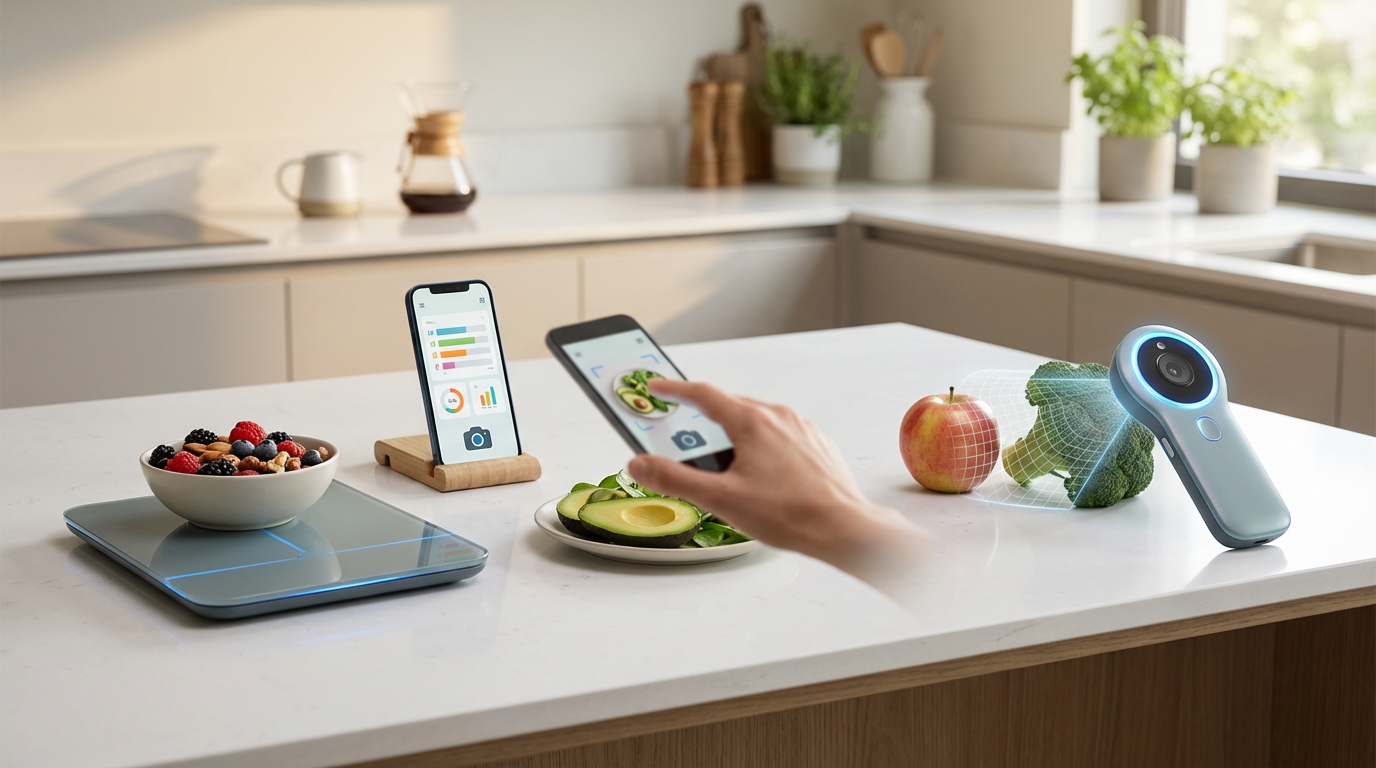
AI Food Scanner vs AI Kitchen Scale: Which Is More Accurate?
AI Food Scanner vs AI Kitchen Scale: Which Is More Accurate?
You snap a photo of your lunch, wait for the app to analyze it, and get a calorie estimate that seems... questionable. Sound familiar? If you're tracking calories for fat loss or monitoring macros, you've probably wondered whether an ai food scanner app is actually giving you reliable numbers.
The truth is, accuracy matters when you're working toward specific body composition goals. A 200-calorie error here and there can derail your progress over time. So which approach gives you better results: scanning food with your phone camera or weighing it on a smart scale?
Let's break down the real-world accuracy of both methods and help you choose the right tool for your goals.
How AI Food Scanners Work
AI food scanner apps use computer vision to identify foods in photos. You point your camera at a meal, the app recognizes what it sees, and estimates portion sizes based on visual cues.
The technology has improved dramatically in recent years. Modern apps can distinguish between similar foods (like white rice vs. cauliflower rice) and even identify mixed dishes with multiple ingredients.
But here's the challenge: estimating portion size from a 2D image is inherently difficult. The app has to guess how much food is actually there based on visual references.
Popular AI Food Scanner Apps
Several apps have gained popularity in the food photo apps comparison space:
- MyFitnessPal: Added photo scanning to their established database
- Lose It!: Snap It feature for quick photo logging
- Yazio: AI-powered food recognition with macro breakdowns
- Cronometer: Photo feature combined with detailed nutrient data
Each app uses slightly different algorithms, which means you might get different calorie estimates for the same meal across platforms.
How AI Kitchen Scales Work
Smart kitchen scales take a different approach. They measure the actual weight of your food, then use that precise measurement with nutritional databases to calculate calories and macros.
Some scales connect to apps that can identify foods through barcodes or manual selection. Others use AI to recognize foods placed on the scale, combining visual recognition with weight data.
The key advantage? Weight doesn't lie. A 150-gram chicken breast is always 150 grams, regardless of camera angles or lighting conditions.
Accuracy Comparison: The Numbers
AI Food Scanner Accuracy
Research on food photo estimation shows mixed results. Studies have found that photo-based calorie estimates can be off by 20-50% in either direction.
The accuracy depends heavily on:
- Food type: Simple, single foods (like an apple) are easier to estimate than complex mixed dishes
- Portion size: Larger portions tend to be underestimated more than smaller ones
- Photo quality: Lighting, angle, and background all affect recognition
- Reference objects: Some apps work better when you include a coin or utensil for scale
For example, a photo of pasta might be estimated at 300 calories when the actual portion contains 450 calories. That's a significant difference if you're trying to maintain a specific calorie deficit.
AI Kitchen Scale Accuracy
Digital kitchen scales are typically accurate within 1-2 grams. When combined with reliable nutritional databases, this translates to very precise calorie and macro calculations.
The main variables affecting accuracy are:
- Database quality: How accurate are the nutritional values for each food?
- Food preparation: Raw vs. cooked weights can differ significantly
- Brand variations: Different brands of the same food can have varying nutritional profiles
A quality smart scale with a comprehensive database can achieve 95%+ accuracy for calorie estimation.
Real-World Testing Scenarios
Let's look at how these methods perform with common foods:
Scenario 1: Mixed Salad
AI Food Scanner: Struggles to identify all ingredients and estimate quantities of each component. Might miss the dressing entirely or underestimate nuts and cheese.
AI Kitchen Scale: You weigh each ingredient as you add it. Perfect accuracy for total weight, very high accuracy for calories if you select the right foods in the app.
Scenario 2: Restaurant Meal
AI Food Scanner: More practical since you can't weigh restaurant food. Accuracy varies widely depending on preparation method and hidden ingredients.
AI Kitchen Scale: Not feasible unless you're eating at home.
Scenario 3: Packaged Snack
AI Food Scanner: Can often read nutrition labels or recognize branded products. Decent accuracy if the app's database is current.
AI Kitchen Scale: Excellent accuracy, especially if you scan the barcode and weigh the actual portion.
Pros and Cons Breakdown
AI Food Scanner Advantages
- Speed: Snap and go in seconds
- Convenience: Works anywhere, no extra equipment
- Restaurant-friendly: Only option for meals you didn't prepare
- Social situations: Less conspicuous than pulling out a scale
AI Food Scanner Disadvantages
- Inconsistent accuracy: Can be off by 20-50%
- Struggles with mixed dishes: Hard to identify all ingredients
- Lighting dependent: Poor photos = poor estimates
- Portion size errors: Especially problematic for calorie-dense foods
AI Kitchen Scale Advantages
- High accuracy: 95%+ when used properly
- Precise portions: No guessing about serving sizes
- Better for meal prep: Easily portion out exact amounts
- Macro precision: Critical if you're tracking protein, carbs, and fats closely
AI Kitchen Scale Disadvantages
- Home use only: Can't bring it to restaurants
- Extra step: Takes more time than snapping a photo
- Learning curve: Need to understand raw vs. cooked weights
- Initial cost: Quality scales cost more than free apps
When to Use Each Method
Best way to scan food depends on your situation:
Choose AI food scanners when:
- Eating out frequently
- Prioritizing speed over precision
- Tracking general trends rather than exact numbers
- In social situations where weighing food isn't practical
Choose AI kitchen scales when:
- Preparing most meals at home
- Working toward specific body composition goals
- Tracking macros for athletic performance
- Need consistent, reliable data
The Hybrid Approach
Many successful trackers use both methods strategically. They rely on precise weighing at home and photo scanning when eating out. This gives you the best of both worlds: accuracy when possible, convenience when necessary.
Some people use photo scanning as a backup verification method. Weigh your food, then take a photo to see if the AI estimate aligns with your measured portion. This can help calibrate your visual estimation skills over time.
Common Mistakes to Avoid
With AI Food Scanners
- Trusting every estimate: Always sense-check the results
- Poor photo technique: Take clear, well-lit photos with reference objects
- Ignoring mixed dishes: Break down complex meals into components when possible
- Forgetting condiments: Sauces and dressings add up quickly
With AI Kitchen Scales
- Raw vs. cooked confusion: 100g raw chicken ≠ 100g cooked chicken
- Forgetting to tare: Always zero out the container weight
- Using generic entries: Choose specific brands when available
- Inconsistent timing: Weigh at the same stage of preparation each time
Technology Improvements on the Horizon
Both technologies continue evolving rapidly. AI food scanners are getting better at recognizing complex dishes and estimating portions. Some apps now ask follow-up questions to refine their estimates.
Smart scales are becoming more sophisticated too. Qalzy represents the next generation of AI-powered kitchen scales, combining precise weight measurements with intelligent food recognition to streamline the tracking process.
The future likely holds even more integration between these approaches, with apps that can learn from both your weighing patterns and photo habits.
Making Your Choice
For most people serious about calorie estimation accuracy, a smart kitchen scale provides the foundation for reliable tracking. The precision matters when you're working toward specific goals.
That said, AI food scanners serve an important role for meals you can't control. The key is understanding each method's limitations and using them appropriately.
If you're just starting with calorie tracking, begin with whatever method you'll actually use consistently. Imperfect data that you collect regularly beats perfect data you abandon after a week.
For those ready to invest in more precise tracking, consider tools like Qalzy's smart scale and app, which combines the accuracy of weighing with AI assistance to make the process faster and more intuitive than traditional manual logging.
Frequently Asked Questions
Q: Can AI food scanners recognize homemade recipes? A: Most struggle with unique homemade dishes. They work better with common recipes or when you can break down the meal into individual ingredients.
Q: How accurate are smart kitchen scales for liquids? A: Very accurate for measuring volume by weight. Most apps can convert between grams and milliliters for common liquids like milk or oil.
Q: Do I need to weigh food raw or cooked? A: Either works, but be consistent and choose the matching database entry. Raw weights are often more accurate since cooking methods vary.
Q: Which method is better for tracking macros specifically? A: Kitchen scales provide much more precise macro tracking, which matters if you're following specific protein, carb, or fat targets.
Q: Can I improve AI food scanner accuracy? A: Yes, by taking clear photos, including reference objects, manually adjusting portion sizes, and breaking complex dishes into components.
Q: Are expensive smart scales worth it over basic digital scales? A: Smart scales with good apps save time and reduce errors, but a basic accurate scale plus a nutrition app can work well too.
The bottom line? Both AI food scanners and smart kitchen scales have their place in modern nutrition tracking. Choose based on your lifestyle, goals, and tolerance for precision. The best tool is the one you'll actually use consistently to support your health journey.