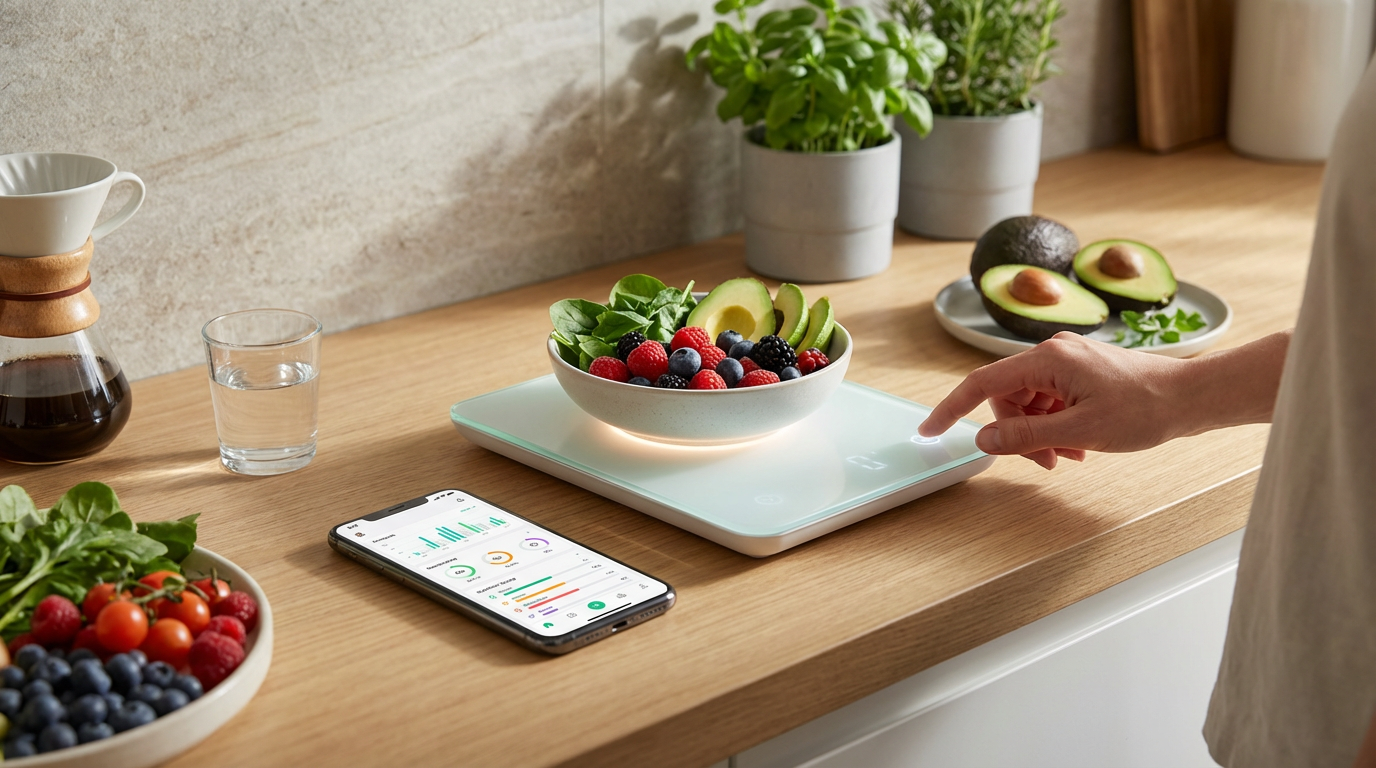
AI Kitchen Scale vs Calorie Tracking Apps: Which Wins?
AI Kitchen Scale vs Calorie Tracking Apps: Which Is More Accurate?
You've tried tracking calories before. You know the drill: scan a barcode, guess the portion size, scroll through endless food databases, and hope you're getting somewhere close to accurate numbers. Some days you nail it. Other days you give up halfway through logging lunch.
The ai kitchen scale vs calorie tracking apps debate isn't just about technology—it's about finding a method that actually works in your real kitchen, with your actual schedule, without making you want to throw your phone across the room.
Let's break down which approach gives you better accuracy, saves more time, and actually helps you hit your nutrition goals.
The Current State of Calorie Tracking
Most people start their nutrition journey with a smartphone app. MyFitnessPal, Cronometer, Lose It—the options are endless. These apps have massive food databases and barcode scanners that make tracking feel almost magical at first.
But here's what happens in practice:
- You scan a banana and get 17 different entries with wildly different calorie counts
- You eyeball "one cup" of rice and wonder if you're off by 200 calories
- You spend five minutes searching for "homemade chicken stir fry" and settle for something that's probably wrong
- You forget to log your afternoon snack and try to remember what you ate at 11 PM
The National Institutes of Health found that people typically underestimate their calorie intake by 20-40%. That's not because we're bad at math—it's because portion estimation is genuinely difficult.
How AI Kitchen Scales Change the Game
AI-powered kitchen scales flip the script entirely. Instead of you doing the detective work, the scale identifies your food and calculates nutrition automatically.
Here's how they work:
- Place food on the scale
- The AI identifies what you're weighing (using visual recognition or connected app data)
- Get instant nutrition data based on the exact weight
- Log automatically to your tracking app
The accuracy difference is significant. While manual calorie logging relies on your ability to estimate portions and find the right database entry, AI scales measure precise weights and match them to verified nutrition data.
Calorie Tracking Accuracy: The Real Numbers
Let's talk specifics. When you log "1 medium apple" in a traditional app, you're accepting whatever calorie count the database provides—usually around 80-95 calories. But apples vary dramatically in size. A small apple might be 55 calories. A large one could hit 130 calories.
With manual calorie logging, you're making these estimation errors constantly:
- Cooking oils: Easy to underestimate by 100-200 calories per meal
- Nuts and seeds: Dense calories that add up fast when portions drift
- Condiments and sauces: Often forgotten or underestimated
- Leftovers and mixed dishes: Nearly impossible to log accurately
AI kitchen scales eliminate most of these errors by weighing everything precisely. When you place 150 grams of chicken breast on the scale, you get nutrition data for exactly 150 grams—not "one medium chicken breast" or whatever approximation you might choose in an app.
Food Scanner Apps vs Physical Weighing
Food scanner apps promised to solve the accuracy problem. Point your camera at food, get instant nutrition info. In practice, they're hit-or-miss.
Scanner apps work well for:
- Packaged foods with clear labels
- Simple, single-ingredient items
- Foods with distinctive visual characteristics
They struggle with:
- Mixed dishes and recipes
- Foods that look similar (different types of bread, various cuts of meat)
- Portion size estimation (they might identify pizza, but how big is that slice?)
- Lighting conditions and photo quality
Physical weighing removes the guesswork entirely. The scale doesn't care if your kitchen lighting is dim or if your stir-fry has six different ingredients mixed together.
Time and Convenience: The Daily Reality Check
This is where things get interesting. Traditional nutrition app comparison often focuses on features and databases, but the real question is: which method will you actually use consistently?
Traditional App Tracking Time Investment:
- Search food database: 30-60 seconds
- Select correct entry: 15-30 seconds
- Estimate portion size: 10-20 seconds
- Log and verify: 10-15 seconds
- Total per food item: 65-125 seconds
For a meal with 4-5 components, you're looking at 5-10 minutes of active logging time.
AI Scale Tracking Time:
- Place food on scale: 5 seconds
- Wait for identification: 10-15 seconds
- Confirm and log: 5-10 seconds
- Total per food item: 20-30 seconds
The time savings compound quickly. More importantly, the mental effort is dramatically reduced. You don't need to make decisions or search through options—just weigh and move on.
Common Mistakes That Kill Tracking Accuracy
Whether you choose apps or scales, certain mistakes will sabotage your results:
The "Close Enough" Trap: Picking the first reasonable-looking database entry instead of the most accurate one. This can easily add 10-20% error to your daily totals.
Forgetting Cooking Methods: Raw chicken breast and grilled chicken breast have different nutrition profiles. Many people log the raw values even when eating cooked food.
Oil and Fat Blindness: Not accounting for cooking oils, butter, or other added fats. These are calorie-dense and add up fast.
Weekend Amnesia: Tracking perfectly Monday through Friday, then abandoning all logging on weekends. Your body doesn't take weekends off.
Liquid Calories: Forgetting to track drinks, smoothies, protein shakes, or alcohol.
AI scales help prevent several of these mistakes by making logging so quick and automatic that you're more likely to track everything consistently.
The Hybrid Approach: Best of Both Worlds
Here's what many successful trackers discover: you don't have to choose just one method.
Use AI scales for:
- Home cooking and meal prep
- Ingredients you use frequently
- Foods where portion size matters most (proteins, fats, calorie-dense items)
Use traditional apps for:
- Restaurant meals
- Packaged foods with reliable labels
- Travel and situations where you can't access a scale
This hybrid approach maximizes accuracy where it matters most while maintaining flexibility for real-world situations.
When AI Scales Make the Biggest Difference
AI kitchen scales shine in specific scenarios:
Meal Prep Sessions: When you're preparing multiple meals at once, the speed and accuracy of scale-based tracking becomes invaluable. You can portion and log entire weeks of meals in minutes.
Macro Tracking: If you're tracking protein, carbs, and fats (not just calories), precision matters more. A 20-gram error in nuts could throw off your fat macros significantly.
Plateau Busting: When weight loss stalls, tightening up tracking accuracy often reveals hidden calories that were derailing progress.
Family Cooking: Preparing meals for multiple people with different nutrition goals becomes much easier when you can quickly weigh individual portions.
The Technology Behind Smart Nutrition Tracking
Modern AI scales like Qalzy combine several technologies to deliver accurate results:
- High-precision sensors that measure to the gram
- Food recognition AI trained on thousands of food images and data points
- Nutrition databases with verified macro and micronutrient information
- Recipe calculation that breaks down complex dishes into individual components
- Learning algorithms that improve accuracy over time based on your specific foods and habits
The result is a system that gets smarter the more you use it, while requiring less effort from you.
Cost-Benefit Analysis: Apps vs AI Scales
Traditional Calorie Tracking Apps:
- Cost: Free to $10/month for premium features
- Time investment: High daily commitment
- Accuracy: Moderate, depends heavily on user diligence
- Learning curve: Moderate
- Long-term sustainability: Often decreases over time due to logging fatigue
AI Kitchen Scales:
- Cost: Higher upfront investment ($100-300+)
- Time investment: Low daily commitment
- Accuracy: High for home-prepared foods
- Learning curve: Low
- Long-term sustainability: Higher due to reduced friction
The break-even point often comes down to consistency. If an AI scale helps you track accurately for months instead of abandoning manual logging after weeks, the investment pays off in results.
Making Your Decision: Which Approach Fits Your Life?
Choose traditional apps if:
- You eat out frequently
- You're just starting with nutrition tracking
- You prefer flexibility over precision
- Budget is a primary concern
- You don't mind spending time on detailed logging
Choose an AI scale if:
- You cook most meals at home
- You've struggled with logging consistency before
- Accuracy is crucial for your goals
- You value time savings in your daily routine
- You're serious about long-term nutrition tracking
Consider a hybrid approach if:
- You want maximum accuracy and flexibility
- Your eating patterns vary significantly
- You're willing to invest in multiple tools for better results
The Future of Nutrition Tracking
The ai kitchen scale vs calorie tracking apps debate is evolving rapidly. We're seeing:
- Better integration between scales and popular tracking apps
- Improved AI recognition that handles complex meals more accurately
- Wearable integration that considers your activity and metabolism
- Personalized recommendations based on your specific response to different foods
The goal isn't perfect tracking—it's sustainable tracking that helps you reach your goals without taking over your life.
Getting Started: Your Next Steps
If you're ready to upgrade your nutrition tracking, start by honestly assessing your current challenges:
- Track your tracking: For one week, note how much time you spend logging food and how often you skip meals or snacks
- Identify your biggest pain points: Is it portion estimation? Finding the right database entries? Forgetting to log?
- Consider your cooking habits: Do you prepare most meals at home, or do you rely heavily on restaurants and takeout?
- Evaluate your goals: Are you trying to lose weight, maintain, or optimize performance? Different goals may require different levels of precision
Tools like Qalzy's nutrition calculator can help you understand your specific calorie and macro needs, which informs how precise your tracking needs to be.
FAQ
How accurate are AI kitchen scales compared to manual logging? AI kitchen scales typically achieve 95%+ accuracy for portion sizes, while manual logging averages 60-80% accuracy due to estimation errors. The biggest accuracy gains come from precise weight measurements and elimination of portion guessing.
Can AI scales identify complex recipes and mixed dishes? Modern AI scales can identify many common mixed dishes, but complex homemade recipes may require ingredient-by-ingredient logging. Some scales allow you to save custom recipes for future use.
Do I need to use a scale for everything I eat? No. Many successful users employ a hybrid approach—using scales for home cooking and calorie-dense foods while relying on apps for restaurant meals and packaged items.
How long does it take to see results with more accurate tracking? Most people notice better progress consistency within 2-4 weeks of improved tracking accuracy. The key is identifying and closing gaps in your previous logging method.
Are AI kitchen scales worth it for casual dieters? If you cook regularly at home and have struggled with tracking consistency, AI scales often pay for themselves in time savings and better results. For very casual tracking, traditional apps may be sufficient.
What happens when I eat away from home? AI scales work best as part of a complete tracking system. Most users pair them with mobile apps for restaurant meals, travel, and social eating situations.
The choice between AI kitchen scales and traditional calorie tracking apps isn't about finding the "perfect" solution—it's about finding the approach that works consistently in your actual life. Whether that's the precision of smart scales, the flexibility of mobile apps, or a combination of both, the best tracking method is the one you'll actually use long-term.
Ready to experience the difference that precise, effortless tracking can make? Explore Qalzy's smart nutrition tracking system and discover how AI-powered tools can transform your relationship with food logging from a daily chore into a simple, automatic habit.