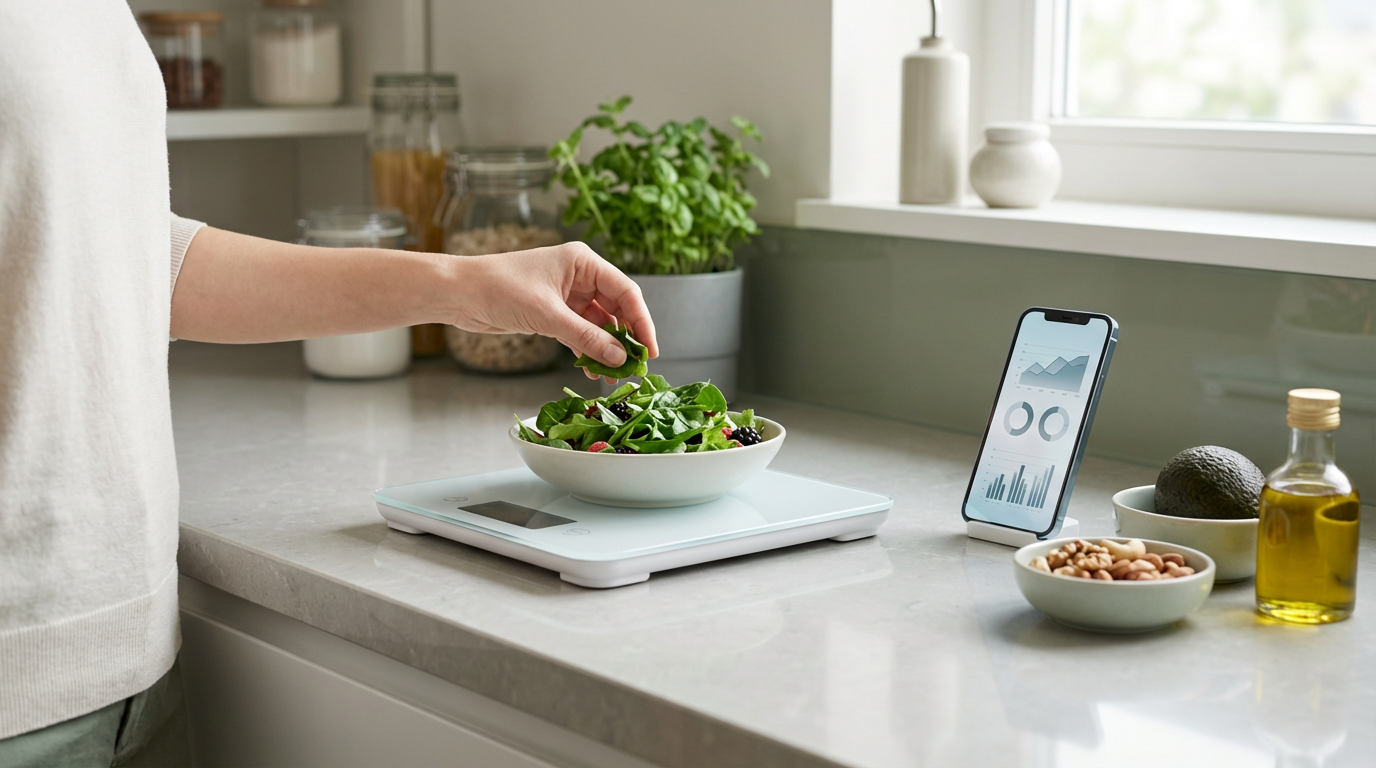
AI Kitchen Scale for Weight Loss: Smart Portion Control Guide
How an AI Kitchen Scale for Weight Loss Transforms Your Portion Control
You've probably been there. Standing in your kitchen, eyeballing a serving of pasta, wondering if that mound on your plate is closer to 100 grams or 200. The difference? About 220 calories that could make or break your weight loss progress.
Manual portion estimation is where most diets quietly fail. We're terrible at guessing food amounts, and traditional food logging feels like homework nobody wants to do. An ai kitchen scale for weight loss changes this entirely by removing the guesswork and tedium from accurate nutrition tracking.
Smart kitchen scales equipped with AI technology don't just weigh your food—they identify it, calculate calories automatically, and track your intake without the endless database searching that makes most people quit logging after two weeks.
Why Traditional Portion Control Methods Fall Short
Most people trying to lose weight start with good intentions. They download a calorie tracking app, promise to measure everything, and begin logging meals with enthusiasm.
Then reality hits.
Searching through thousands of food entries for "chicken breast, grilled, no skin" takes forever. Was it the entry with 165 calories per 100g or 185? Which brand matches what you actually ate? After a few days of this friction, most people default back to eyeballing portions or abandon tracking altogether.
Research shows we consistently underestimate portion sizes by 20-40%. That "small" bowl of cereal you think is 30 grams? It's probably closer to 50. Those extra 20 grams add roughly 75 calories—and when this happens across multiple meals daily, your carefully planned calorie deficit disappears.
How AI Kitchen Scales Work for Weight Loss
An AI-powered kitchen scale functions as your personal nutrition assistant. Here's the basic process:
Visual Recognition: Built-in cameras or smartphone integration identify foods automatically. Place an apple on the scale, and it knows it's an apple—no searching required.
Instant Calculations: The AI calculates calories, protein, carbs, and fats based on the exact weight. No more wondering if you should log 0.75 servings or 1.2 servings of something.
Learning Capabilities: Advanced models learn your eating patterns and common foods, getting faster and more accurate over time.
Seamless Logging: Data syncs directly to your phone or nutrition app. Your meal gets logged automatically while you're still cooking.
This portion control tool eliminates the two biggest barriers to successful food tracking: time and accuracy.
The Science Behind Portion Control and Weight Loss
Weight loss fundamentally requires a calorie deficit—burning more calories than you consume. But creating that deficit requires knowing how much you're actually eating, not how much you think you're eating.
Studies published in obesity research journals consistently show that people who accurately track their food intake lose significantly more weight than those who don't. The key word is "accurately."
Portion control matters because calorie density varies wildly between foods. A tablespoon of olive oil contains 120 calories. A full cup of spinach has 7 calories. When you're eyeballing portions, it's easy to drastically underestimate calorie-dense foods while being overly cautious with low-calorie vegetables.
A smart scale for dieting provides the precision needed to maintain a consistent calorie deficit without the mental math and guesswork that derail most attempts.
Key Benefits of AI Kitchen Scales for Weight Loss
Eliminates Portion Guesswork
Your eyes lie to you about food portions. A "medium" banana can range from 80 to 130 calories depending on actual size. With precise measurements, you know exactly what you're consuming.
Speeds Up Food Logging
Traditional apps require searching, selecting, and adjusting portions. Smart scales handle identification and calculation instantly. What used to take 2-3 minutes per food item now takes seconds.
Improves Macro Tracking Accuracy
If you're tracking protein, carbs, and fats for specific fitness goals, accuracy becomes even more critical. A smart scale for dieting ensures your macro ratios match your targets.
Builds Better Food Awareness
Using precise measurements teaches you what proper portions actually look like. Over time, you develop more accurate portion intuition for situations where you can't weigh food.
Provides Calorie Deficit Support
Maintaining a calorie deficit requires consistency. When tracking is easy and accurate, you're more likely to stick with it long-term.
Practical Features That Make the Biggest Difference
Multi-Food Recognition
The best AI scales can identify multiple foods on the same plate. Making a salad with five ingredients? The scale recognizes and weighs each component separately.
Recipe Integration
Some models connect with recipe apps or databases, automatically calculating nutrition for complex dishes based on ingredients and portions.
Meal Memory
Smart scales remember your common meals and portions, making repeat logging even faster.
Nutritional Insights
Beyond basic calories, advanced models provide detailed nutritional breakdowns including vitamins, minerals, and micronutrients.
Common Mistakes When Using Kitchen Scales for Weight Loss
Weighing Cooked vs. Raw Foods Inconsistently
Nutritional databases often list raw weights, but you might weigh after cooking. A 100g raw chicken breast becomes about 75g when cooked, but the calories remain the same. Stay consistent with your measuring approach.
Forgetting to Account for Cooking Oils and Seasonings
That "grilled" chicken isn't calorie-free if you used oil in the pan. Small additions add up quickly.
Only Weighing "Healthy" Foods
Some people meticulously weigh vegetables but eyeball nuts, oils, or treats. Calorie-dense foods need the most precision.
Abandoning the Scale Too Quickly
Building accurate portion awareness takes time. Don't expect perfect intuition after a week of weighing food.
Choosing the Right AI Kitchen Scale
Not all smart scales offer the same features. Consider these factors:
Food Database Size: Larger databases mean better food recognition accuracy.
App Integration: Look for scales that sync with your preferred nutrition tracking app.
Recognition Speed: The best models identify foods in 2-3 seconds.
Accuracy Range: Professional-grade scales measure to 0.1g increments.
Multi-Language Support: Important if you cook diverse cuisines.
Real-World Example: A Day with Smart Portion Control
Sarah wants to lose 20 pounds and maintain a 500-calorie daily deficit. Here's how her AI kitchen scale transforms a typical day:
Breakfast: She places her bowl on the scale, adds oatmeal until it reads 40g (150 calories), then adds blueberries to 80g (45 calories). The scale recognizes both foods instantly and logs them to her app. Total time: 30 seconds.
Lunch: Making a salad with six ingredients that would normally require six separate database searches and portion calculations. Her smart scale identifies everything automatically and provides the complete nutritional breakdown. Total time: 45 seconds.
Dinner: Grilled salmon with vegetables. The scale weighs the 120g salmon portion (240 calories) and mixed vegetables (35 calories). Again, instant recognition and logging.
Without the scale, this level of accuracy would require 10-15 minutes of manual logging daily. With it, she spends less than 2 minutes while achieving professional-level tracking precision.
How AI Kitchen Scales Support Long-Term Weight Loss Success
Weight loss nutrition isn't just about short-term calorie counting. It's about building sustainable habits that support long-term health.
Smart scales contribute to lasting success by:
Reducing Tracking Fatigue: When logging is quick and automatic, you're more likely to maintain consistency for months, not just weeks.
Teaching Accurate Portion Awareness: Regular use trains your eye to recognize proper portions even when you're eating out.
Providing Consistent Data: Accurate tracking helps you identify which foods and portion sizes work best for your body and goals.
Supporting Maintenance Phase: After reaching your goal weight, continued accurate tracking helps prevent gradual weight regain.
Integration with Modern Weight Loss Approaches
AI kitchen scales work particularly well with evidence-based weight loss strategies:
Flexible Dieting: When you can accurately track any food, you have more flexibility in your meal choices while maintaining your calorie deficit.
Macro Counting: Precise macro tracking becomes feasible for average people, not just dedicated bodybuilders.
Intuitive Eating Transition: Accurate measurement helps you learn true hunger and satiety cues without the confusion of portion distortion.
The Technology Behind Food Recognition
Modern AI scales use computer vision and machine learning to identify foods. They're trained on thousands of food images and continuously improve their recognition accuracy.
Some models use smartphone cameras, while others have built-in imaging systems. The best systems combine visual recognition with weight data to provide more accurate nutritional calculations than either method alone.
For foods the AI can't identify, most scales allow manual entry that gets added to their learning database, improving future recognition.
Making the Investment Work for You
A quality AI kitchen scale represents a significant upgrade from basic digital scales, but the time savings and accuracy improvements often justify the cost for serious dieters.
Consider the math: if manual food logging takes an extra 10 minutes daily, that's over 60 hours per year. For many people, the time savings alone make smart scales worthwhile.
More importantly, the improved accuracy can mean the difference between successful weight loss and frustrating plateaus caused by underestimated portions.
Getting Started with Smart Portion Control
If you're ready to upgrade your portion control tool approach, start by identifying your current tracking pain points. Do you struggle with database searches? Portion calculations? Consistency?
AI kitchen scales address all these issues, but they work best when integrated into a comprehensive approach to weight loss nutrition.
For those interested in experiencing truly effortless food tracking, Qalzy combines an AI-powered kitchen scale with intelligent nutrition software that learns your eating patterns and makes calorie counting feel automatic rather than tedious.
The key is choosing tools that reduce friction rather than add complexity to your daily routine. Smart scales excel at this by handling the tedious parts of nutrition tracking while you focus on making good food choices.
Frequently Asked Questions
Q: How accurate are AI kitchen scales compared to manual logging? A: AI scales typically achieve 95%+ accuracy for food identification and provide precise weight measurements to 0.1g. This is significantly more accurate than eyeballed portions and faster than manual database searching.
Q: Do I need to weigh every single thing I eat? A: For best results during active weight loss, yes. However, once you develop accurate portion awareness, you can be more selective about what you weigh while maintaining your results.
Q: What happens if the scale doesn't recognize a food? A: Most AI scales allow manual entry for unrecognized foods. This data often gets added to their learning database, improving future recognition for you and other users.
Q: Are smart scales worth it for maintenance after reaching my goal weight? A: Many people find them valuable for maintenance because they prevent the gradual portion creep that leads to weight regain. The convenience makes it easier to spot-check your intake periodically.
Q: How do AI kitchen scales handle mixed dishes and recipes? A: Advanced models can recognize multiple ingredients simultaneously and some integrate with recipe databases. For complex dishes, you may need to weigh ingredients separately during cooking.
Q: Can I use a smart scale with any nutrition tracking app? A: Most AI scales sync with popular apps like MyFitnessPal, but some work best with their proprietary software. Check compatibility before purchasing.
Transform Your Weight Loss Journey
Accurate portion control doesn't have to be complicated or time-consuming. The right ai kitchen scale for weight loss eliminates guesswork while making food tracking feel effortless rather than burdensome.
Whether you're just starting your weight loss journey or looking to break through a plateau, precise nutrition tracking provides the foundation for sustainable success. Smart scales simply make that precision achievable for busy, real-world lifestyles.
Ready to experience the difference that effortless, accurate tracking can make? Explore how Qalzy's AI-powered approach transforms nutrition tracking from a chore into a seamless part of your daily routine. With the right tools, reaching your weight loss goals becomes a matter of consistency, not complexity.