Best Way to Track Macros Without Spending Hours Daily
The Best Way to Track Macros Without Spending Hours on Every Meal
You know that sinking feeling when you sit down to log your lunch and realize you've got seven different ingredients to weigh, measure, and input? Twenty minutes later, you're still hunting for the right entry for "chicken breast, grilled, no skin" while your food gets cold.
Macro tracking works. The science is clear on that. But when it takes longer to log your meal than it did to cook it, something's broken.
The best way to track macros isn't about finding the perfect app or weighing every grain of rice. It's about building a system that's accurate enough to get results without turning every meal into a data entry marathon.
Let's fix your macro tracking so you can actually enjoy your food again.
Why Most People Quit Macro Tracking
The average person who starts macro tracking quits within three weeks. Not because it doesn't work, but because it becomes a part-time job.
Here's what typically happens:
- Week 1: You're motivated. You log everything meticulously.
- Week 2: You start skipping the handful of nuts or that splash of milk in your coffee.
- Week 3: You're eyeballing portions and making wild guesses.
- Week 4: You've given up entirely.
The problem isn't willpower. It's that most macro tracking methods are designed by people who've never had to log a family dinner while three kids are asking for help with homework.
Smart Strategies for Quick Calorie Logging
Start with the 80/20 Rule
Eighty percent of your macro intake probably comes from 20% of the foods you eat regularly. Instead of trying to track every single thing, focus on nailing your staples.
Make a list of your 15-20 most common foods. Create saved meals for your typical breakfast, lunch, and snacks. When you eat these foods, logging takes seconds instead of minutes.
Use Recipe Scaling
Cook a big batch of something? Log the entire recipe once, then just adjust the serving size each time you eat it. Made a huge pot of chili with 8 servings? Log it once, save it, then just select "0.5 servings" or "1.2 servings" as needed.
This works especially well for:
- Soups and stews
- Casseroles
- Meal prep containers
- Smoothies
- Homemade protein bars
Master the Art of Food Swapping
Once you know the macros for chicken breast, you can quickly estimate other lean proteins. 100g of chicken breast has roughly the same protein as 100g of white fish or lean turkey.
Similarly, if you know your usual rice serving, you can estimate other grains pretty accurately. The goal isn't perfection—it's consistency.
Protein Carb Fat Tracking Made Simple
Focus on Protein First
Protein is usually the hardest macro to hit and the most important for body composition. Track protein obsessively, but be more relaxed with carbs and fats.
Most whole food carb sources are pretty predictable. A medium apple is about 25g carbs. A slice of bread is 15-20g. A cup of cooked rice is about 45g. Learn these basics and you can estimate quickly.
Fats are often easier to control at the cooking stage. Use a measured amount of oil, butter, or nuts, then you know exactly what you're getting.
Use Visual Cues for Speed
Your palm is roughly 20-25g protein. Your cupped hand is about 20-30g carbs. Your thumb is roughly 10-15g fat.
These aren't perfect, but they're consistent. Use them when you're eating out or when precise weighing isn't practical.
Pre-Plan Your Day
Spend 5 minutes each morning planning your main meals. Log them before you eat them. Then you know exactly how much room you have for snacks and extras.
This prevents the "end of day panic" where you realize you've got 200 calories left but need 40g protein.
Easy Macro Counting Tools That Actually Work
Smart Kitchen Scales
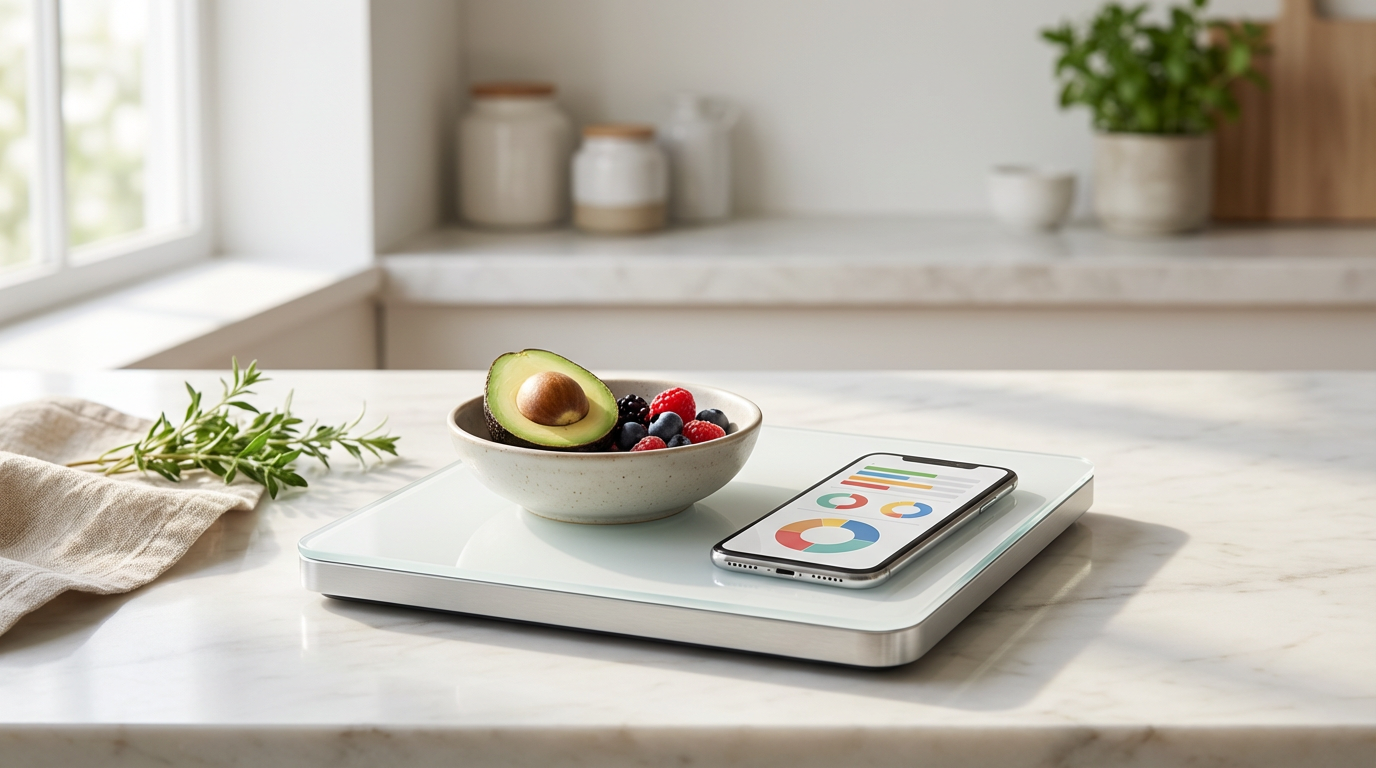
A regular food scale is helpful, but smart scales can be game-changers for macro tracking. Qalzy's AI-powered kitchen scale connects directly to your phone and can identify foods automatically, eliminating most of the manual logging that makes tracking so tedious.
Instead of weighing chicken, opening your app, searching for "chicken breast," selecting the right entry, and inputting the weight, you simply place the food on the scale. The AI recognizes it and logs the macros instantly.
Barcode Scanning
For packaged foods, barcode scanning is non-negotiable. It's faster and more accurate than searching. Most tracking apps have this feature—use it religiously.
Voice Logging
Some apps let you speak your entries: "100 grams chicken breast, 150 grams sweet potato, 10 grams olive oil." This is much faster than typing, especially for multi-ingredient meals.
Common Macro Tracking Mistakes That Waste Time
Tracking Everything to the Gram
That 3g of ketchup isn't going to make or break your results. Neither is the 5g of onion in your salad. Focus your precision on calorie-dense foods and foods that make up the bulk of your intake.
Constantly Switching Apps
Every app has different food databases and slightly different macro values. Constantly switching means you're always learning new interfaces and dealing with inconsistent data. Pick one app and stick with it.
Not Using Saved Meals
If you eat the same breakfast three times a week, save it as a meal. If you make the same post-workout smoothie every day, save it. Most people eat more repetitively than they realize.
Obsessing Over Restaurant Meals
Eating out once or twice a week won't derail your progress, even if your logging isn't perfect. Make your best estimate and move on. The stress of trying to perfectly log a restaurant meal often isn't worth it.
Building a Sustainable System
Start Simple
Begin by tracking just protein for a week. Once that feels easy, add carbs. Then fats. Don't try to track everything perfectly from day one.
Batch Your Logging
Instead of logging each meal as you eat it, some people prefer to log their entire day at once. Find a quiet 10 minutes in the evening and input everything. This can feel less disruptive than stopping to log throughout the day.
Accept "Good Enough"
A tracking system that's 85% accurate but sustainable will beat a system that's 98% accurate but makes you want to quit after two weeks.
Consistency trumps perfection every single time.
When to Consider Upgrading Your Tools
If you're spending more than 15 minutes a day on food logging, it's time to look at better tools. Traditional apps require too much manual work for most people to stick with long-term.
Modern solutions like Qalzy use AI to eliminate most of the tedious parts of macro tracking. The scale recognizes foods automatically, calculates portions instantly, and syncs everything to your phone without manual input.
This isn't about being lazy—it's about removing friction from a process that's already challenging enough.
Sample Day: Fast Macro Tracking in Action
Breakfast (2 minutes to log):
- Saved meal: "My usual oatmeal" (oats, protein powder, berries, almond butter)
- Just adjust the portion size if you made more or less than usual
Lunch (1 minute to log):
- Pre-logged this morning when planning your day
- Weigh the main components, estimate the small stuff
Snack (30 seconds to log):
- Greek yogurt: barcode scan
- Berries: quick estimate based on visual cues
Dinner (3 minutes to log):
- Saved recipe from meal prep Sunday
- Just select your portion size
Total logging time: Under 7 minutes for the entire day.
Making It Work Long-Term
The best macro tracking system is the one you'll actually use consistently. That might mean accepting less precision in exchange for more sustainability.
Some people thrive on detailed logging. Others need a more relaxed approach. Figure out which type you are and build your system accordingly.
Remember: the goal isn't to track macros forever. It's to learn about portions, understand your eating patterns, and develop intuition about food choices. Most people can transition to intuitive eating after 6-12 months of consistent tracking.
FAQ
How accurate does macro tracking need to be to see results? For most goals, being within 10-15% of your targets is sufficient. Perfect accuracy isn't necessary—consistency is what drives results.
Should I track macros on weekends and holidays? This depends on your goals and lifestyle. Many people track Monday through Friday and take a more relaxed approach on weekends. Find a balance that works for your life.
What's the fastest way to track macros when eating out? Look for chain restaurants that provide nutrition information, or find similar meals in your tracking app from restaurants that do provide data. Don't stress about perfect accuracy.
How long should I expect to spend on macro tracking each day? With good systems in place, 5-10 minutes per day is realistic. If you're spending significantly more, you need better tools or simpler methods.
Is it worth investing in a smart kitchen scale for macro tracking? If you cook most of your meals at home and plan to track for more than a few months, a smart scale can save significant time and improve accuracy. Calculate your macro needs first to see if detailed tracking makes sense for your goals.
Can I track macros without weighing food? Yes, using portion control methods and visual cues. It's less accurate but more sustainable for some people. The key is being consistent with whatever method you choose.
The Bottom Line
The best way to track macros is the method you'll actually stick with. That usually means prioritizing speed and simplicity over perfect precision.
Start with the basics: focus on protein, use saved meals, and don't sweat the small stuff. As you get more comfortable, you can add tools like smart scales or more detailed logging if they help rather than hinder your progress.
Remember, macro tracking is a tool, not a lifestyle. Use it to learn, then gradually transition to a more intuitive approach as your understanding of nutrition improves.
Ready to streamline your nutrition tracking? Explore Qalzy's smart kitchen solutions and see how AI can make macro tracking as simple as placing food on a scale.