Food Scale vs Calorie App: Which Is More Accurate?
You've been logging your meals religiously for weeks, but the scale isn't budging. Sound familiar? The frustrating truth is that inaccurate calorie tracking might be sabotaging your progress before you even realize it.
The debate between using a food scale vs calorie app for tracking isn't just about convenience—it's about getting results. When your calorie deficit depends on precision, even small tracking errors can derail your fat loss goals.
Let's break down which method actually delivers better calorie tracking accuracy and how you can optimize your approach.
Why Calorie Tracking Accuracy Matters
Before diving into tools, here's the reality: most people underestimate their calorie intake by 20-40%. That's not a small margin of error—it's the difference between losing weight and staying stuck.
Research shows that portion size estimation is particularly challenging. We're terrible at eyeballing serving sizes, especially for calorie-dense foods like nuts, oils, and cheese.
This accuracy gap matters because:
- A 500-calorie daily deficit becomes a 100-calorie surplus with just 25% underestimation
- Small tracking errors compound over weeks and months
- Inconsistent data makes it impossible to adjust your approach effectively
Food Scales: The Precision Advantage
A kitchen scale calories approach removes guesswork from portion size estimation. When you weigh 28 grams of almonds instead of counting "a handful," you're working with actual data.
Pros of Using a Food Scale
Objective measurements: No room for interpretation. 100 grams of chicken breast is 100 grams, regardless of how hungry you feel.
Consistency over time: Your tracking stays reliable even when your visual perception changes or you're eating in different environments.
Better for calorie-dense foods: Weighing oils, nuts, and sauces prevents the massive underestimation that kills progress.
Macro precision: If you're tracking protein, carbs, and fats, weighing gives you the accuracy needed for body composition goals.
Cons of Food Scale Tracking
Time investment: Weighing every ingredient adds 5-10 minutes to meal prep and eating.
Social awkwardness: Bringing a scale to restaurants or friends' houses isn't always practical.
Portability issues: You're tied to your kitchen scale for accurate tracking.
Potential for obsessive behavior: Some people develop an unhealthy relationship with weighing every morsel.
Calorie Apps: The Convenience Factor
Modern nutrition tracking apps have massive food databases and user-friendly interfaces. You can log meals in seconds and track your intake anywhere.
Pros of App-Only Tracking
Speed and convenience: Quick barcode scans and search functions make logging effortless.
Social flexibility: Easy to use at restaurants, parties, or while traveling.
Built-in guidance: Most apps provide macro targets, progress charts, and educational content.
Lower barrier to entry: No equipment needed—just download and start tracking.
Cons of App-Only Tracking
Portion size guesswork: "Medium apple" or "1 cup pasta" leaves room for significant error.
Database inconsistencies: Different entries for the same food can vary wildly in accuracy.
User input errors: It's easy to select the wrong food item or misjudge portion sizes.
Overconfidence in estimates: Apps make imprecise tracking feel precise, creating false confidence.
The Accuracy Showdown: Food Scale vs Calorie App
So which method actually wins for calorie counting accuracy?
For single ingredients and simple meals: Food scales dominate. Weighing raw chicken, rice, or vegetables gives you precise calorie and macro data that apps can't match through estimation alone.
For packaged foods: Apps have an edge here, especially with barcode scanning. A food scale won't help you track the exact nutrition info from a specific brand's protein bar.
For complex recipes: This is where both methods struggle. Restaurant meals, homemade dishes with multiple ingredients, and foods prepared by others are challenging to track accurately regardless of your tool.
For long-term consistency: Food scales win by removing human error from portion estimation. Your tracking accuracy doesn't decline when you're tired, hungry, or distracted.
The research backs this up. Studies on calorie tracking accuracy consistently show that people who weigh their food achieve better results than those relying on visual estimates alone.
Smart Food Scale Technology: Best of Both Worlds
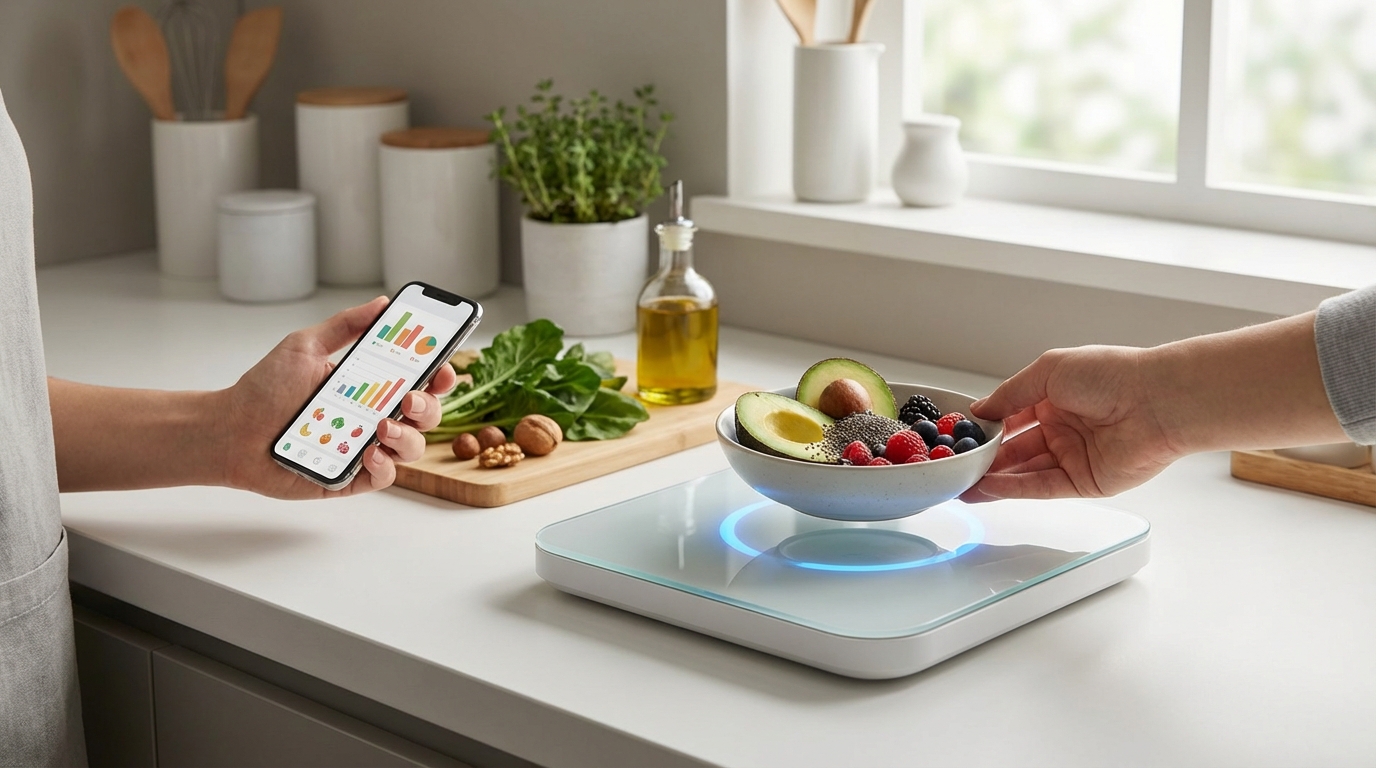
Here's where the food scale vs calorie app debate gets interesting. Smart kitchen scales now combine the precision of weighing with the convenience of app integration.
Qalzy's AI-powered kitchen scale exemplifies this hybrid approach. Instead of weighing your food and then manually searching through app databases, the scale identifies ingredients automatically and logs nutrition data in real-time.
This solves several key problems:
- Eliminates double work: No need to weigh food and then spend time logging it separately
- Reduces user error: AI recognition prevents selecting wrong food items
- Maintains precision: You get scale-accurate portions with app-level convenience
- Speeds up the process: Track calories accurately without sacrificing time
Common Tracking Mistakes That Kill Accuracy
Regardless of which method you choose, avoid these accuracy killers:
Forgetting cooking oils and condiments: That tablespoon of olive oil adds 120 calories. The mayo on your sandwich contributes another 100.
Using volume instead of weight for solids: A "cup" of nuts can vary by 50+ calories depending on how tightly packed it is.
Not accounting for food preparation: Raw vs cooked weights differ significantly. 100g of raw rice becomes about 300g when cooked.
Weekend tracking gaps: Being precise Monday through Friday but going off-script on weekends undermines your weekly deficit.
Trusting restaurant "light" or "healthy" options: These dishes often contain hidden calories from oils, sauces, and larger portions than expected.
Practical Strategy: When to Use Each Method
You don't have to choose just one approach. Here's how to optimize your strategy:
Use a food scale for:
- Home meal prep and cooking
- Calorie-dense foods (nuts, oils, cheese, dried fruits)
- The first few weeks of tracking to calibrate your portion estimates
- When you're not seeing expected results and need to troubleshoot accuracy
Use app-only tracking for:
- Packaged foods with nutrition labels
- Restaurant meals (with realistic portion adjustments)
- Social situations where weighing isn't practical
- Quick snacks and beverages
Consider a smart food scale when:
- You want scale-level accuracy without the time investment
- Manual logging feels tedious and inconsistent
- You're serious about body composition goals that require macro precision
The Bottom Line on Tracking Accuracy
The food scale vs calorie app question isn't really about choosing sides—it's about understanding the strengths and limitations of each approach.
Food scales deliver superior accuracy for portion control and calorie counting, especially at home. Apps provide unmatched convenience and work better for complex or social eating situations.
For most people trying to lose fat or track macros effectively, some combination of both methods works best. Use the scale when precision matters most, and lean on apps when convenience is the priority.
The key is consistency. Perfect tracking that you abandon after two weeks won't beat good-enough tracking that you maintain for months.
Frequently Asked Questions
Q: Do I really need a food scale to lose weight? A: Not necessarily, but it significantly improves your tracking accuracy. If you're not seeing results with app-only tracking, a scale can help identify where your estimates are off.
Q: How much more accurate is weighing food compared to estimating? A: Studies show people typically underestimate portions by 20-40%. Weighing food can reduce this error to less than 5% for most ingredients.
Q: Are smart food scales worth the investment? A: If you're committed to accurate tracking but find manual logging tedious, smart scales like Qalzy can provide the best of both worlds—scale precision with app convenience.
Q: Should I weigh food before or after cooking? A: Weigh ingredients in their raw state when possible, as this matches most nutrition database entries. Cooked weights can vary significantly based on preparation method.
Q: How do I track calories when eating out? A: Use your app to find similar restaurant items, but consider adding 10-20% extra calories to account for hidden oils and larger portions. Some restaurant chains provide detailed nutrition information online.
Q: Can I switch between methods without affecting my progress? A: Yes, but be aware that your average daily calories might shift when you change tracking methods. Monitor your results and adjust your targets if needed.
Take Your Tracking to the Next Level
Ready to stop guessing and start getting real results? Whether you choose a traditional food scale, stick with app-only tracking, or upgrade to a smart solution, the most important step is committing to consistency.
If you're looking for the accuracy of a food scale without the hassle of manual logging, explore how Qalzy's AI-powered approach can streamline your nutrition tracking. Sometimes the best tool is the one that removes friction from building healthy habits.
For more nutrition tracking tips and strategies, check out our comprehensive guide to macro tracking or use our calorie calculator to dial in your daily targets.
The right tracking method is the one you'll actually use consistently. Choose your approach, stay committed, and let accurate data guide your progress toward your goals.