How to Count Calories Accurately When Cooking at Home
How to Count Calories Accurately When Cooking at Home
You're crushing your fitness goals all week, carefully tracking every bite. Then Sunday rolls around and you decide to cook a homemade stir-fry. Suddenly you're staring at your food tracking app, completely stumped. How many calories are actually in this delicious mess you just created?
Learning how to count calories accurately when you cook at home doesn't have to feel like solving a complex math equation. With the right approach and tools, you can track your homemade meals just as precisely as packaged foods—without turning your kitchen into a laboratory.
Why Home Cooking Makes Calorie Counting Tricky
Restaurant meals and packaged foods come with nutrition labels. Your grandmother's lasagna recipe? Not so much.
When you cook at home, you're dealing with multiple ingredients, cooking methods that change calorie density, and portion sizes that vary every time. Oil gets absorbed into vegetables. Water evaporates from meat. Ingredients get mixed together in ways that make individual portions nearly impossible to eyeball.
The good news? Home cooking gives you complete control over what goes into your food. Once you master a few key techniques, you'll actually get more accurate calorie counts than you ever could with restaurant meals.
The Foundation: Weigh Food for Calories, Don't Guess
Forgive the bluntness, but measuring cups are terrible for calorie counting. A "cup" of shredded cheese can vary by 50+ calories depending on how tightly you pack it. A tablespoon of peanut butter? Good luck getting consistent results.
A digital kitchen scale changes everything. When you weigh ingredients in grams, you get precise measurements every time. No more wondering if your "medium" banana was actually large, or whether that handful of nuts just cost you 200 calories.
Kitchen Scale Tracking Basics
Start with a scale that measures in grams and has a "tare" or "zero" function. This lets you place a bowl on the scale, zero it out, then add ingredients one by one while tracking the exact weight of each.
For example, making a smoothie becomes simple:
- Place blender on scale, zero it out
- Add 150g banana (record: 150g banana)
- Zero the scale again
- Add 240g milk (record: 240g milk)
- Zero and repeat for each ingredient
This method works for any recipe, from simple snacks to complex casseroles.
Recipe Calorie Calculator Strategies That Actually Work
Method 1: The Ingredient List Approach
This is the most accurate method for dishes where ingredients don't change dramatically during cooking (think salads, smoothies, or cold preparations).
- Weigh every ingredient before cooking
- Look up calories per gram for each ingredient
- Add up total calories for the entire recipe
- Weigh your portion and calculate your share
Let's say your salad recipe totals 800 calories and weighs 600g total. If your portion weighs 150g, you're eating 200 calories (150g ÷ 600g × 800 calories = 200).
Method 2: The Cooked Weight Method
For dishes that change significantly during cooking, weigh the final product and divide by portions.
- Track all raw ingredients and their calories
- Cook the dish completely
- Weigh the finished product
- Divide into equal portions by weight
This works brilliantly for stews, casseroles, and one-pot meals where ingredients merge together.
Method 3: The Component Tracking Method
Some dishes are easier to track by separating components. Think of a stir-fry where you can track the protein, vegetables, oil, and sauce separately, even though they're cooked together.
This approach gives you flexibility while maintaining accuracy. You might weigh your chicken breast raw, track the oil you used for cooking, and weigh your portion of vegetables separately.
Handling Common Home Cooking Scenarios
Oils and Cooking Fats
This is where many people's calorie counts go completely wrong. That "splash" of olive oil in your pan? It could easily be 200-300 calories.
Measure oil before it goes in the pan. If you're cooking for multiple people and not all the oil gets absorbed, you can estimate absorption rates (vegetables typically absorb 60-80% of cooking oil, while proteins absorb less).
Recipes That Serve "4-6 People"
Forget serving size estimates. They're basically useless for calorie counting.
Instead, calculate total recipe calories, then weigh your actual portion. If you eat 25% of the total weight, you're getting 25% of the calories. Simple.
Leftovers and Meal Prep
When you make a big batch, divide it into containers immediately and weigh each one. Label containers with the weight and calories. Your future self will thank you when you're grabbing lunch and don't need to do math.
How to Count Calories Accurately for Complex Dishes
Some recipes feel impossible to track. Here's how to handle the tricky ones:
Soups and Stews
Track all ingredients going in. The final weight will be less than the sum of ingredients due to evaporation, but the calories remain the same. Weigh the finished soup and divide by portions.
Baked Goods
Baking is actually perfect for calorie counting because you can be incredibly precise. Weigh your flour, sugar, oil, and other ingredients. After baking, weigh the finished product and cut into portions by weight.
Mixed Dishes Like Casseroles
Use the cooked weight method. Track every ingredient that goes into the dish, cook it completely, then weigh the result. Each gram of the finished casserole contains the same calorie density.
Common Mistakes That Sabotage Accuracy
Forgetting About Cooking Methods
Grilling, roasting, and other dry-heat methods concentrate calories by removing water. A 100g piece of raw chicken breast might weigh 75g after cooking, but it still contains the same calories.
Track based on raw weight when possible, or learn the conversion rates for your favorite proteins.
Ignoring Small Additions
That squeeze of lemon juice might only be 5 calories, but the butter you melted over your vegetables could be 100+. Small additions add up quickly.
Inconsistent Measuring
Pick a system and stick with it. If you usually track raw weights, always track raw weights. Switching between raw and cooked measurements for the same foods will throw off your accuracy.
Not Accounting for Recipe Variations
Your "usual" chicken stir-fry probably varies by 20-30% in ingredients each time you make it. Don't just copy and paste previous entries—track each cooking session separately.
Smart Tools That Make Home Cooking Calories Easier
While you can absolutely track home cooking calories with just a scale and a basic app, some tools make the process much smoother.
Traditional calorie counting apps require you to search for each ingredient, estimate portions, and do mental math to figure out your serving size. It works, but it's tedious enough that many people eventually give up.
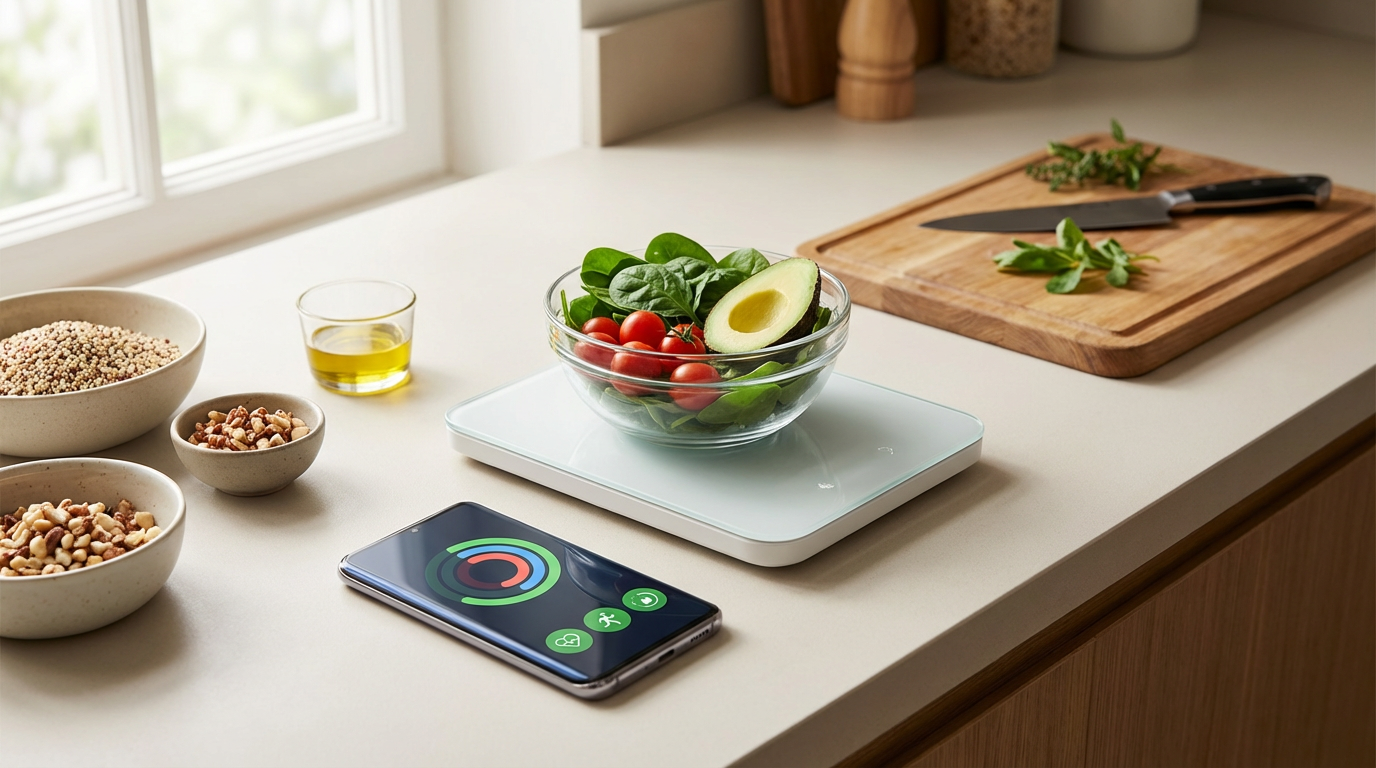
Qalzy's AI-powered approach changes this completely. Instead of manually logging each ingredient, you simply place ingredients on the smart scale as you cook. The AI recognizes what you're adding and automatically calculates calories and macros for your exact portion.
This is particularly helpful for complex recipes where you might have 8-10 ingredients. Instead of stopping to log each one individually, you can focus on cooking while the system handles the tracking in the background.
The recipe calculator feature also lets you save your favorite homemade dishes, so you can quickly track them again without re-entering all the ingredients.
Making It Sustainable Long-Term
The most accurate calorie counting system in the world won't help if you abandon it after two weeks. Here's how to make home cooking calorie tracking stick:
Start Simple
Begin with recipes that have 3-5 ingredients. Master the process with simple dishes before tackling complex ones.
Batch Cook and Pre-Calculate
Make large batches of staple foods and calculate calories once. Store in pre-portioned containers so you can grab and go without recalculating.
Focus on Your Most Common Dishes
You probably cook the same 10-15 dishes regularly. Get really good at tracking those, rather than trying to be perfect with every single meal.
Use Technology Wisely
Find tools that reduce friction rather than adding complexity. The goal is to make tracking easier, not to turn every meal into a science experiment.
Sample Day: Putting It All Together
Here's what accurate home cooking calorie tracking looks like in practice:
Breakfast: Scrambled eggs with vegetables
- Weigh 2 eggs (about 100g): 140 calories
- Measure 1 tsp oil (4g): 36 calories
- Weigh mixed vegetables (80g): 25 calories
- Total: 201 calories
Lunch: Leftover chicken stir-fry (pre-calculated)
- Grab pre-portioned container: 380 calories
Dinner: Homemade chili (cooking for 4)
- Calculate total recipe calories: 1,200
- Weigh finished chili: 800g total
- Your portion: 200g
- Your calories: 300 (200g ÷ 800g × 1,200 calories)
Notice how you only need to do detailed calculations once per recipe, then use simple math for portions.
Advanced Tips for Recipe Calorie Accuracy
Account for Cooking Losses
Meat loses about 25% of its weight when cooked due to water loss. Vegetables vary more widely. If you track raw weights, you don't need to worry about this. If you track cooked weights, learn the typical shrinkage rates for your favorite foods.
Handle Marinades and Sauces
Most marinades don't fully absorb into food. A conservative estimate is that proteins absorb about 10-20% of liquid marinades. For thick sauces that coat food completely, count the full amount.
Track Cooking Water for Grains
Rice and pasta absorb water but no additional calories when cooked. Track the dry weight, then divide cooked portions proportionally. 100g dry rice becomes about 300g cooked rice with the same calories.
Frequently Asked Questions
Do I need to weigh every single ingredient? For accuracy, yes—especially calorie-dense ingredients like oils, nuts, cheese, and proteins. You can be more relaxed with very low-calorie items like herbs, spices, or lettuce.
What if I'm cooking for my family and can't weigh individual portions? Calculate the total recipe calories, weigh the finished dish, then weigh your individual portion. Your percentage of the total weight equals your percentage of total calories.
How do I handle recipes where some oil stays in the pan? This is tricky. You can either count all the oil you added (slightly overestimating) or estimate absorption rates. Most vegetables absorb 60-80% of cooking oil.
Should I track ingredients raw or cooked? Raw weights are generally more accurate because nutrition databases typically use raw values. Pick one method and stay consistent.
What about complex recipes with 15+ ingredients? These are perfect candidates for smart tracking tools. Manual logging becomes tedious with complex recipes, but AI-powered systems can handle the complexity automatically.
How accurate do I really need to be? For weight loss, being within 10-15% is usually sufficient. Perfect accuracy matters less than consistency over time.
The Bottom Line
Accurate calorie counting for home cooking comes down to three key principles: weigh your ingredients, calculate total recipe calories, and portion by weight rather than guesswork.
Yes, it requires more effort than grabbing packaged foods. But the payoff is huge—you get complete control over your nutrition while still enjoying delicious, satisfying meals.
The initial learning curve might feel steep, but most people find their groove within a few weeks. Once you've tracked your favorite recipes a few times, the process becomes almost automatic.
If you're ready to take the guesswork out of home cooking calories, consider tools that can streamline the process. Qalzy's smart kitchen scale and AI tracking can handle the complex calculations automatically, letting you focus on cooking great food instead of doing math.
Start with one simple recipe this week. Weigh the ingredients, calculate the totals, and portion it out precisely. You might be surprised by how much more confident you feel about your calorie targets when you actually know what you're eating.