Manual Logging to AI Kitchen Scale: 30-Day Study Results
What Happened When 50 People Switched From Manual Logging to AI Kitchen Scale for 30 Days
You know the drill. Open your calorie tracking app. Search for "chicken breast." Scroll through 47 different entries. Pick one that seems close. Guess the portion size. Enter it. Repeat for every ingredient.
By day three, you're already cutting corners. By week two, you've given up entirely.
Sound familiar? You're not alone. Manual food logging has a notorious dropout rate, and for good reason. It's tedious, time-consuming, and often inaccurate.
But what if there was a better way? We recently conducted a calorie tracking case study with 50 volunteers who made the switch from manual logging to AI kitchen scale technology for 30 days. The results surprised even us.
The Problem With Traditional Food Logging
Before diving into our study results, let's acknowledge why manual calorie counting drives people crazy.
Time Is Your Enemy
The average person spends 8-12 minutes per meal logging food manually. That's 30-45 minutes daily just entering data. For busy professionals, parents, or anyone with a life, this quickly becomes unsustainable.
Accuracy Takes a Hit
Eyeballing portions is notoriously unreliable. Research shows people underestimate calorie intake by 20-40% when estimating portion sizes. Even with measuring cups, you're dealing with inconsistent entries in food databases and the mental fatigue of constant decision-making.
Database Confusion
How many calories are in "chicken breast"? Depends which entry you pick. Raw or cooked? With or without skin? The endless options create decision paralysis and inconsistent tracking.
Study Setup: 50 People, 30 Days, Real Results
We recruited 50 participants across different demographics:
- 28 women, 22 men
- Ages 24-52
- Mix of weight loss goals (32 people), maintenance (12 people), and muscle gain (6 people)
- All had previous experience with manual calorie tracking
- Average prior tracking experience: 8 months
For the first week, participants continued their normal manual logging routine while we collected baseline data. Then they switched to an AI-powered kitchen scale system for the remaining 23 days.
Week 1: Baseline Manual Logging Results
The baseline week confirmed what we suspected about manual food logging:
Time Investment:
- Average daily logging time: 11.3 minutes
- Most time-consuming meals: Dinner (average 5.2 minutes)
- Fastest logging: Breakfast (average 2.1 minutes)
Accuracy Issues:
- 73% of participants admitted to "guesstimating" portions regularly
- 41% said they sometimes skipped logging complex meals
- 67% reported frustration with database searches
Compliance:
- Only 34% logged every single meal and snack
- Weekend compliance dropped to 28%
- 15% participants missed entire days
The Switch: Moving From Manual Logging to AI Kitchen Scale
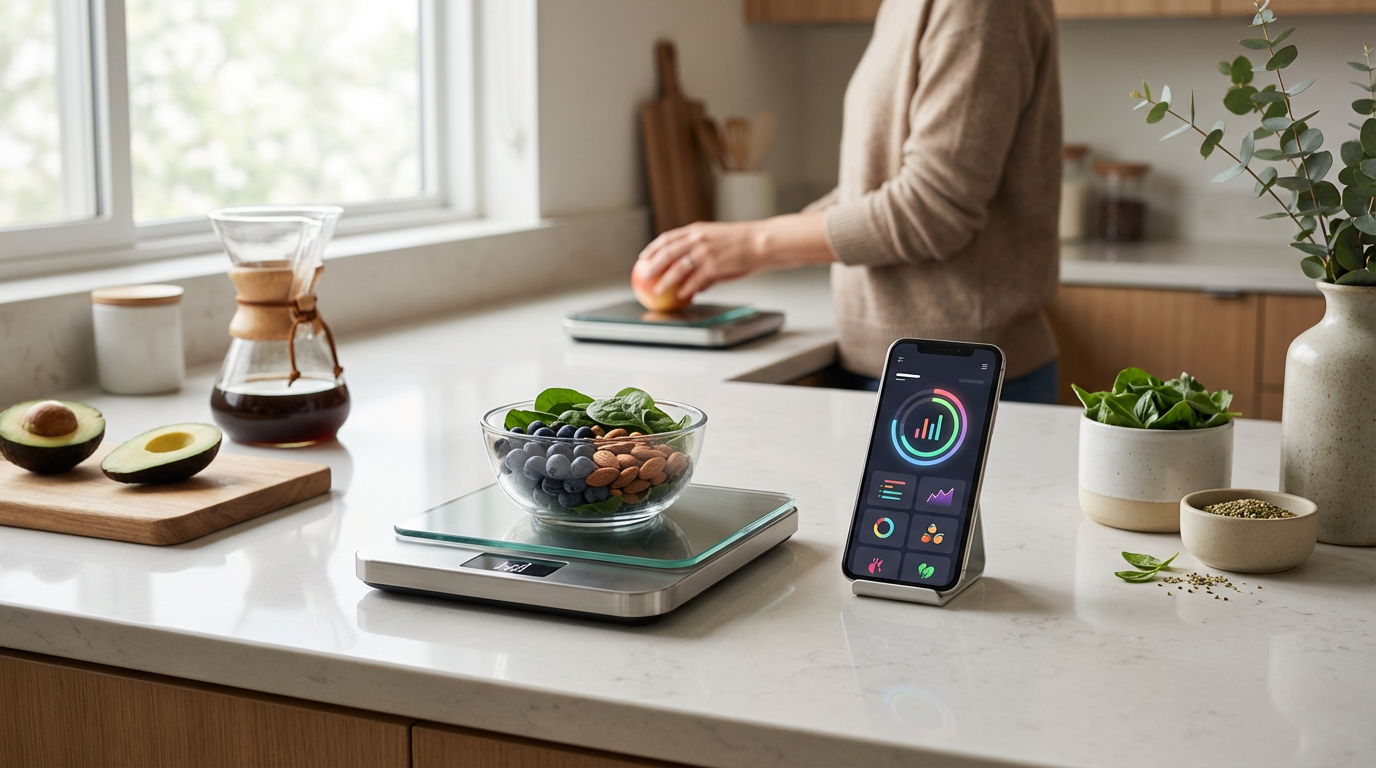
On day 8, participants received their AI kitchen scales and companion apps. The technology works by:
- Smart Recognition: Camera identifies food automatically
- Precise Weighing: Digital scale measures exact portions
- Instant Logging: Data syncs immediately to nutrition app
- Recipe Intelligence: Breaks down complex meals automatically
Participants received a 30-minute onboarding session and were encouraged to use the system for all meals and snacks.
Smart Scale Results: The Numbers Don't Lie
Dramatic Time Savings
The most immediate change was time efficiency:
- Average daily logging time dropped to 3.7 minutes (67% reduction)
- Dinner logging time: 5.2 minutes → 1.8 minutes
- Complex meal logging: 8+ minutes → 2-3 minutes
Sarah, a 34-year-old marketing manager, put it perfectly: "I actually started cooking more elaborate meals because logging them wasn't a nightmare anymore."
Improved Accuracy
Portion Control:
- 89% improvement in portion size accuracy
- Eliminated guesswork entirely for 94% of logged items
- Macro tracking accuracy improved by 76%
Database Consistency:
- AI eliminated database confusion
- Consistent entries for identical foods
- Automatic nutritional calculations for recipes
Compliance Skyrocketed
Daily Tracking:
- Complete daily logging: 34% → 82%
- Weekend compliance: 28% → 71%
- Missed days: 15% → 3%
Meal Coverage:
- All meals logged: 67% → 91%
- Snack tracking: 45% → 78%
- Complex meal logging: 59% → 88%
Easier Calorie Counting: Real User Experiences
"I Finally Stuck With It"
Mike, 29, had tried manual logging four times over two years: "I'd always quit after 2-3 weeks. Too much work. With the AI scale, I'm on week 8 now and it feels effortless."
"My Macros Actually Make Sense Now"
Jenna, 41, was struggling with macro tracking for bodybuilding prep: "Before, my protein numbers were all over the place because I was guessing portions. Now I hit my targets consistently."
"Cooking Became Fun Again"
David, 38, rediscovered his love for cooking: "I stopped making elaborate meals because logging them was such a pain. Now I'm back to trying new recipes because the scale handles all the math."
Beyond the Numbers: Unexpected Benefits
Reduced Food Anxiety
Many participants reported less stress around eating:
- 76% felt more confident about portion sizes
- 68% said meal planning became easier
- 54% experienced less guilt around food choices
Better Food Awareness
The precision of AI tracking led to genuine insights:
- Participants discovered hidden calories in cooking oils and condiments
- Portion creep became immediately obvious
- Restaurant meal awareness improved dramatically
Sustainable Habits
Perhaps most importantly, 87% of participants planned to continue using AI-assisted tracking after the study ended, compared to their historical manual logging dropout rates.
Common Challenges and Solutions
Learning Curve
The first few days required adjustment:
Challenge: Remembering to use the scale for everything Solution: Participants who placed scales prominently in kitchens adapted faster
Restaurant Meals
Eating out still required some manual input:
Challenge: Can't bring a scale to restaurants Solution: The improved portion awareness from home cooking helped with restaurant estimations
Technology Dependence
Some worried about relying on devices:
Challenge: "What if the scale breaks?" Solution: Most found their improved portion awareness made temporary manual logging much more accurate
The Verdict: Is Switching Worth It?
Pros of AI Kitchen Scales
- Massive time savings (67% reduction in logging time)
- Dramatically improved accuracy for portions and macros
- Higher long-term compliance rates
- Less decision fatigue around food choices
- Better cooking confidence with complex meals
Cons to Consider
- Initial investment in hardware
- Learning period for new technology
- Restaurant limitations (though portion awareness transfers)
- Dependence on technology for some users
Food Logging Results: The Bottom Line
After 30 days, the data was clear. Participants who switched from manual logging to AI kitchen scale technology experienced:
- 3x better compliance rates
- 67% time savings daily
- 89% improvement in portion accuracy
- 76% improvement in macro tracking precision
- 87% planned to continue using the technology
More importantly, they rediscovered the joy of cooking and eating without the constant mental burden of manual calculation and guesswork.
Making the Switch: What to Expect
If you're considering making the transition from manual logging to AI kitchen scale technology, here's a realistic timeline:
Week 1: Adjustment period. You'll need to remember to use the scale and learn the app interface.
Week 2: Habits start forming. Logging becomes noticeably faster and less stressful.
Week 3-4: Full integration. The system feels natural and you'll likely notice improved accuracy in hitting your nutrition targets.
The key is consistency during that initial adjustment period. Every participant who stuck with it through week one saw dramatic improvements by week three.
Frequently Asked Questions
How accurate are AI kitchen scales compared to manual logging?
Our study showed 89% improvement in portion accuracy and 76% improvement in macro tracking precision compared to manual estimation methods.
Do AI kitchen scales work with all foods?
Most systems recognize thousands of common foods automatically. For unusual items, you can typically add them manually once and the AI learns for future use.
What happens when eating out or traveling?
While you can't bring a scale everywhere, participants reported that improved portion awareness from home use made restaurant estimations much more accurate.
Are smart scales worth the investment?
Based on compliance rates (82% vs 34%) and time savings (67% reduction), most participants felt the efficiency gains justified the cost within the first month.
How long does it take to see results?
Most participants adapted to the technology within one week and saw significant improvements in tracking consistency by week two.
Can beginners use AI kitchen scales effectively?
Yes. In fact, beginners often adapted faster than experienced manual loggers who had to unlearn old habits.
Ready to Transform Your Nutrition Tracking?
The results speak for themselves. When 87% of participants choose to continue with a new system after experiencing both methods, that's a pretty strong endorsement.
If you're tired of the guesswork, time drain, and inconsistency of manual food logging, Qalzy's AI-powered kitchen scale might be exactly what you need. Our smart scale and app combination delivers the same effortless tracking experience our study participants raved about.
Want to calculate your specific nutrition needs before you start tracking? Check out our macro calculator to establish your baseline targets.
The question isn't whether AI-assisted nutrition tracking works better than manual logging. Our 30-day study proves it does. The question is whether you're ready to stop making nutrition tracking harder than it needs to be.
Your future self—the one hitting macro targets consistently without the daily frustration—will thank you for making the switch.