Smart Macro Scale: Hit Protein, Carbs & Fats Without Math
Smart Macro Scale: Hit Protein, Carbs & Fats Without Manual Math
You know the drill. You're standing in your kitchen with a plate of chicken, rice, and broccoli, trying to calculate if this meal fits your macro targets. Out comes the food scale, followed by frantic app-switching between your tracker and calculator. Fifteen minutes later, you're still doing math instead of eating.
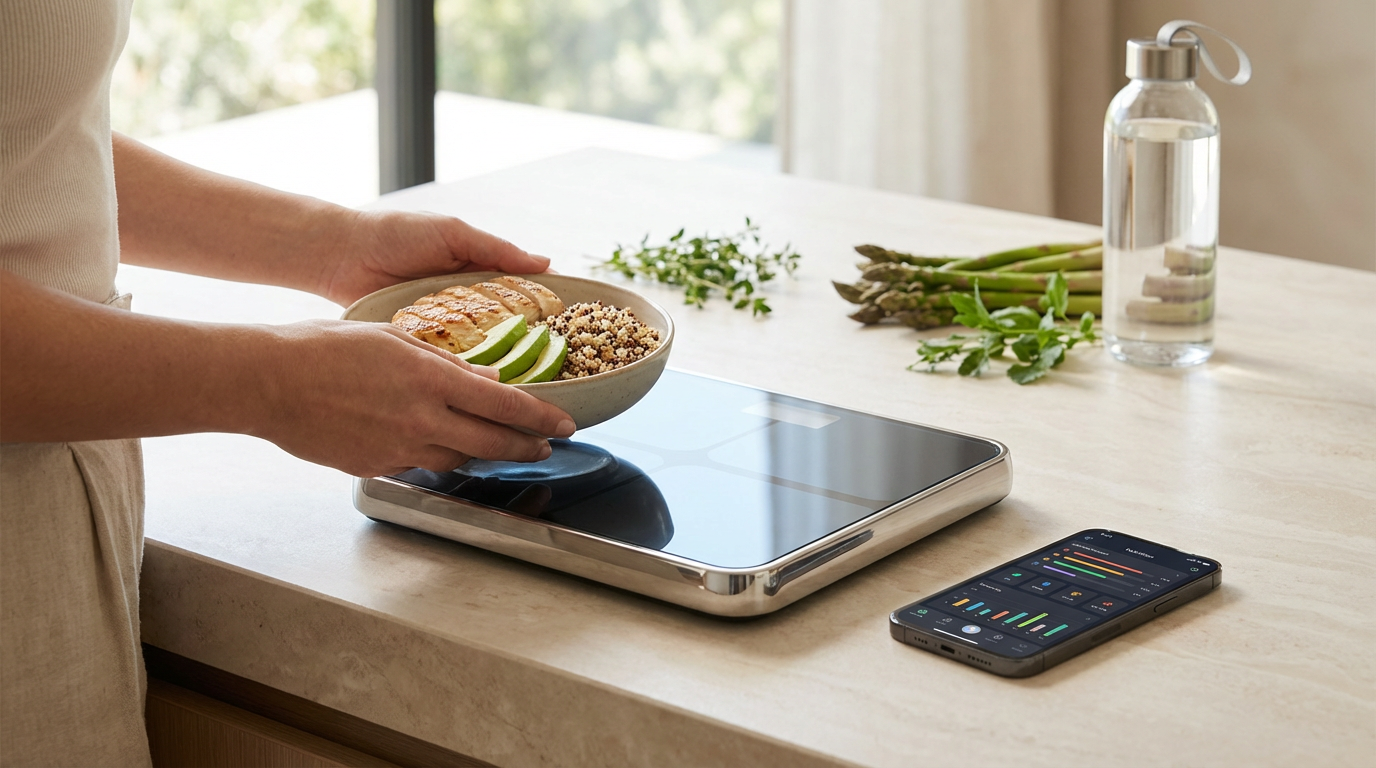
A smart macro scale changes everything. Instead of weighing ingredients and manually calculating protein, carbs, and fats, you get instant macro breakdowns the moment food hits the scale. No more guesswork, no more tedious logging, and definitely no more mental math while your dinner gets cold.
What Makes a Smart Macro Scale Different?
Traditional food scales tell you weight. Smart macro scales tell you nutrition.
When you place 150 grams of chicken breast on a regular scale, you see "150g." When you use a smart macro scale for protein carbs fats tracking, you see the complete picture: 35g protein, 0g carbs, 4g fat, plus calories.
The magic happens through AI-powered food recognition. Advanced models can identify thousands of foods instantly, pulling accurate nutritional data without you typing a single ingredient name. Some connect to smartphone apps that learn your eating patterns and suggest macro-balanced meals.
How Smart Macro Scales Work
The process is surprisingly simple:
- Place food on the scale - The device weighs your ingredient automatically
- Food identification - Built-in AI or connected app recognizes what you're weighing
- Instant macro calculation - Protein, carbs, and fats appear on the display or app
- Running totals - Your daily macro progress updates in real-time
Some advanced models include visual recognition through built-in cameras. Others rely on manual food selection from extensive databases. The best systems combine both approaches, letting you verify AI suggestions while maintaining speed and accuracy.
Database Accuracy Matters
Not all smart scales are created equal. The nutritional database determines everything. Look for systems that use verified USDA data and regularly update their food libraries. Generic "chicken breast" entries vary wildly between brands, but quality databases account for different preparation methods, brands, and regional variations.
Benefits of Automatic Macro Tracking
The time savings alone justify upgrading from manual tracking. But the benefits run deeper:
Consistency improves dramatically. When tracking is effortless, you actually do it. No more "I'll log this later" meals that never get recorded.
Accuracy increases. Human error in manual calculations is common. Smart scales eliminate math mistakes and portion estimation errors.
Meal timing gets better. Faster tracking means you spend less time in the kitchen and more time enjoying properly timed meals.
Learning happens naturally. Seeing instant macro breakdowns teaches you which foods fit your goals without studying nutrition labels.
Smart Macro Scale Features to Look For
Not every smart scale delivers the same experience. Here's what separates the best from the rest:
Essential Features
- Large food database with at least 50,000+ items
- Accurate weight sensors (0.1g precision minimum)
- Fast food recognition (under 3 seconds)
- Mobile app integration with macro goal setting
- Multiple user profiles for families
Advanced Features Worth Having
- Recipe scaling that adjusts macro calculations for different serving sizes
- Meal planning integration that suggests macro-balanced combinations
- Progress tracking with visual charts and trends
- Barcode scanning for packaged foods
- Voice commands for hands-free operation
Nice-to-Have Features
- Wireless charging for connected devices
- Water resistance for easy cleaning
- Multiple weighing modes (grams, ounces, pounds)
- Compact storage design
- Long battery life (6+ months)
Macro-Friendly Meal Prep with Scale Integration
Smart scales shine during meal prep sessions. Traditional prep requires calculating macros for entire recipes, then dividing by servings. Smart scales handle the math automatically.
Here's how it works: Weigh each ingredient as you add it to your prep container. The scale tracks cumulative macros for the entire batch. When you divide into meal containers, it calculates per-serving macros instantly.
Example: You're making a protein-packed stir fry for the week. Add 500g chicken breast, 300g mixed vegetables, 200g brown rice, and 50g sauce. The scale shows total macros: 285g protein, 180g carbs, 25g fat. Divide into 5 containers, and each serving contains 57g protein, 36g carbs, 5g fat.
No spreadsheets. No calculators. Just accurate macro tracking that makes weekly prep actually manageable.
Common Smart Macro Scale Mistakes to Avoid
Trusting Every Food Identification
AI isn't perfect. Always verify that the identified food matches what you're actually weighing. "Chicken breast" could be raw, cooked, seasoned, or breaded. Each has dramatically different macros.
Ignoring Preparation Method
Cooking changes nutritional content. Raw chicken breast has different macros than grilled chicken breast. Quality smart scales account for this, but you need to select the right preparation method.
Forgetting About Cooking Oils and Sauces
That "healthy" grilled chicken becomes macro-heavy when you add olive oil and sauce. Smart scales help track these additions, but only if you remember to weigh them.
Not Calibrating Regularly
Even smart scales need calibration. Check accuracy monthly using known weights. A scale that's off by 10% throws your entire macro tracking off target.
Over-Relying on Estimates
Smart scales excel with whole foods but struggle with complex mixed dishes. Restaurant meals, casseroles, and multi-ingredient foods require more careful attention.
Making Macro Goals Easy with Smart Technology
The best smart macro scales don't just track what you eat—they help you hit your targets. Advanced systems suggest food combinations that complete your daily macro puzzle.
Running low on protein with 200 calories left? The app suggests 40g almonds or 150g Greek yogurt. Need more carbs but want to stay within calorie limits? It recommends 100g sweet potato or 80g oats.
This guidance transforms macro tracking from reactive logging to proactive meal planning. You're not just recording what happened—you're making better decisions in real-time.
Smart Scales vs. Traditional Macro Tracking
Let's be honest about the comparison:
Traditional tracking works, but it's slow and error-prone. You weigh food, look up nutritional info, calculate portions, and log everything manually. It takes 5-10 minutes per meal when done properly.
Smart scale tracking reduces this to under 30 seconds. Place food, confirm identification, done. The accuracy often exceeds manual methods because there's no human calculation error.
The trade-off? Cost and technology dependence. Smart scales cost more than basic digital scales, and they rely on apps and databases that need updates. But for serious macro trackers, the time savings and improved consistency justify the investment.
Getting Started with Smart Macro Tracking
Start simple. Pick one meal per day to track with your smart scale—usually the one you have most control over, like breakfast or lunch. Master the workflow before expanding to full-day tracking.
Set realistic macro targets. If you're new to macro tracking, focus on protein goals first. Once protein becomes automatic, add carb and fat targets. Trying to hit perfect macros from day one leads to frustration and abandoned goals.
Use the learning opportunity. Pay attention to which foods help you hit targets easily. Notice patterns in your eating that work or don't work. Smart scales provide data, but you still need to interpret and act on it.
The Future of Macro Tracking Technology
Smart scales represent just the beginning of automated nutrition tracking. Emerging technologies include:
- Computer vision systems that identify foods through smartphone cameras
- Spectroscopic analysis that measures actual nutritional content, not database estimates
- Integration with fitness trackers for dynamic macro adjustment based on activity
- AI meal planning that optimizes nutrition for individual metabolic profiles
For now, smart macro scales offer the most practical balance of accuracy, speed, and ease of use for serious macro trackers.
Choosing Your Smart Macro Scale Solution
When evaluating options, prioritize accuracy and ease of use over fancy features. A scale that's 95% accurate and used daily beats a 99% accurate scale that's too complicated for regular use.
Consider your tracking style. If you eat similar foods regularly, a scale with learning capabilities saves time. If you're adventurous with cuisine, prioritize extensive food databases and easy manual entry options.
Qalzy's AI-powered kitchen scale exemplifies this balance, combining accurate food recognition with intuitive app integration that makes macro tracking genuinely effortless. The system learns your preferences while maintaining the flexibility to handle new foods and recipes.
Think about integration with your existing tools. If you already use specific fitness apps or meal planning services, choose a scale that connects seamlessly with your current workflow.
Making It Sustainable
The best macro tracking system is the one you'll actually use consistently. Smart scales remove friction from the process, but they can't create motivation. Start with clear goals, track progress regularly, and celebrate improvements in your relationship with food, not just the numbers on the scale.
Remember that macro tracking is a tool, not a lifestyle. Use it to build intuition about nutrition, then gradually rely less on precise measurements as you develop better eating instincts.
Frequently Asked Questions
How accurate are smart macro scales compared to manual tracking? Smart scales with quality databases typically achieve 90-95% accuracy, often exceeding manual tracking because they eliminate human calculation errors and portion estimation mistakes.
Can smart scales identify cooked and prepared foods? Advanced models can distinguish between raw, cooked, grilled, and fried versions of the same food. However, complex mixed dishes still require manual input or recipe building features.
Do I need internet connection for smart macro scales to work? Most smart scales store essential food databases locally and sync with apps when connected. Basic weighing and common food identification work offline, but new food additions require internet access.
How do smart scales handle restaurant meals and takeout? Restaurant foods are challenging for any tracking method. Smart scales help with simple dishes but struggle with complex preparations. Many apps include restaurant chains in their databases for common menu items.
Are smart macro scales worth the cost for casual dieters? If you track macros regularly (4+ days per week), the time savings and improved accuracy usually justify the cost within a few months. Casual trackers might prefer traditional methods.
Can multiple family members use the same smart scale? Most smart scales support multiple user profiles through connected apps, allowing families to track individual macro goals while sharing the same device.
Transform Your Macro Tracking Today
Smart macro scales eliminate the biggest barrier to consistent nutrition tracking: the time and effort required for manual calculations. When hitting your protein, carb, and fat targets becomes as simple as placing food on a scale, macro tracking transforms from a chore into a sustainable habit.
The technology isn't perfect, but it's remarkably effective for the foods that make up most people's diets. If you're serious about reaching your body composition goals and tired of manual macro math, a smart scale might be the upgrade that finally makes consistent tracking stick.
Ready to experience effortless macro tracking? Explore Qalzy's smart kitchen scale and discover how AI-powered nutrition tracking can simplify your health journey without sacrificing accuracy.
For more nutrition tracking tips and macro-friendly recipes, check out our comprehensive cookbook and macro calculator to set your optimal targets.