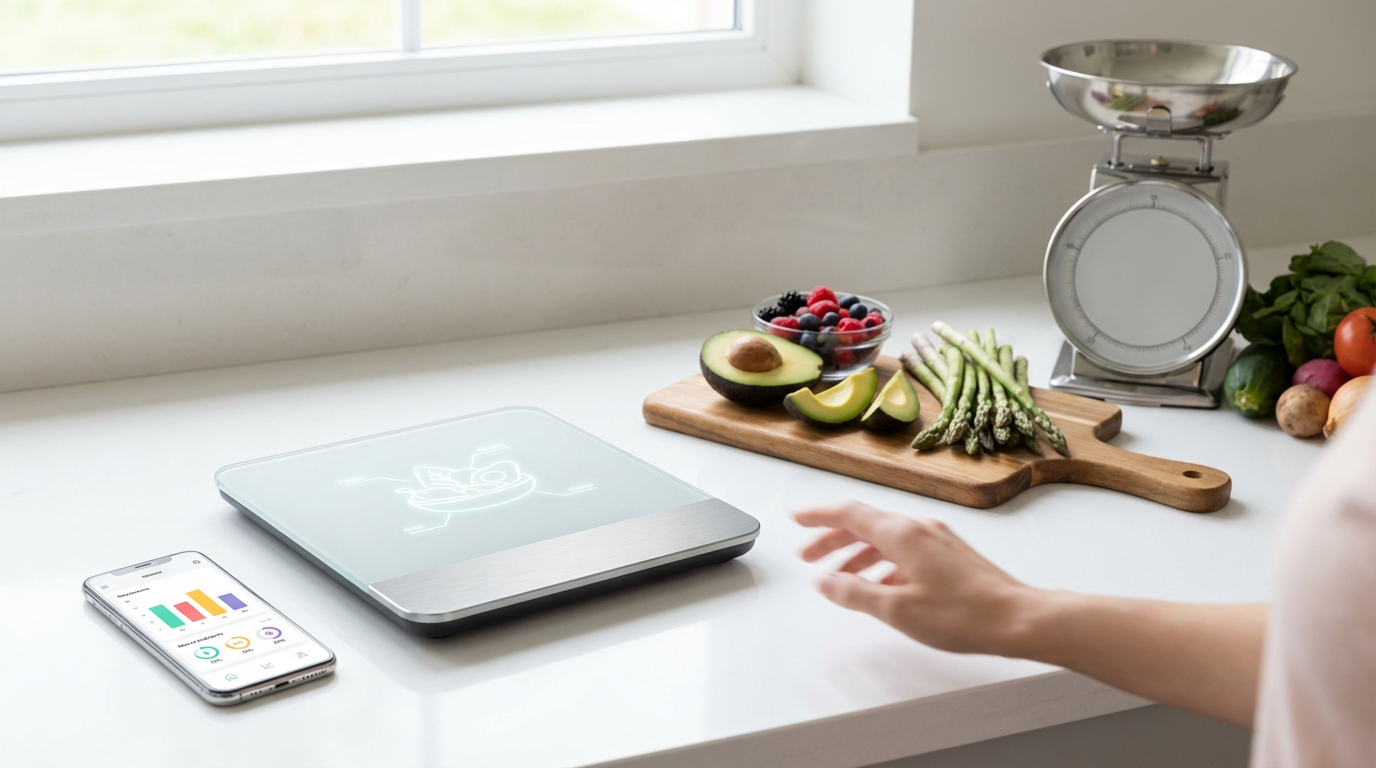
Smart Nutrition Scale vs Traditional Scale: Why Upgrade?
Smart Nutrition Scale vs Traditional Scale: Why the Upgrade Matters
You've been eyeing that sleek digital kitchen scale for months, wondering if it's worth ditching your trusty old one. But here's the thing – not all scales are created equal. While traditional kitchen scales tell you how much your food weighs, a smart nutrition scale tells you exactly what you're eating.
If you're serious about tracking macros, losing fat, or maintaining your weight, this difference changes everything. Let's break down why upgrading from a basic scale to a smart nutrition scale might be the game-changer your health journey needs.
What Makes a Smart Nutrition Scale Different?
Traditional kitchen scales do one job: they weigh stuff. You plop your chicken breast on there, see it's 150 grams, then scramble to look up calories and macros in an app or database.
A smart nutrition scale cuts out the middleman. These devices connect to apps that instantly recognize foods and calculate nutritional information. Some use AI to identify what you're weighing, while others let you select from massive food databases.
The real magic happens when you realize you're not just weighing food anymore – you're building a complete nutritional profile of every meal without the tedious logging that makes most people quit tracking after two weeks.
Traditional Kitchen Scales: The Basics
What They Do Well
Traditional digital scales excel at accuracy and simplicity. A quality model gives you precise measurements down to the gram. They're reliable, affordable, and last for years without much fuss.
For basic cooking and baking, they're perfect. Need exactly 200g of flour? Done. Want to portion out equal servings? Easy.
Where They Fall Short for Nutrition Tracking
The problems start when you want to track what you're eating. Here's the typical workflow:
- Weigh your food
- Open a tracking app
- Search for the food in the database
- Hope you find the right entry among dozens of options
- Enter the weight
- Repeat for every ingredient
This process takes 2-3 minutes per food item. For a mixed meal with 5-6 ingredients, you're looking at 15 minutes of logging. Most people burn out on this routine within weeks.
Smart Nutrition Scale vs Kitchen Scale: The Real Differences
When comparing a smart nutrition scale vs kitchen scale, the gap becomes obvious once you factor in your time and consistency.
Speed and Convenience
A traditional scale forces you to be a nutrition detective. You weigh, then hunt through databases trying to match "chicken breast, raw" versus "chicken breast, cooked" versus "chicken breast, grilled, no skin."
Smart scales eliminate this friction. Place your food, select it from the app (or let AI identify it), and boom – you have calories, protein, carbs, and fat instantly displayed.
Accuracy in Nutrition Data
Here's where things get interesting. Traditional scales are more accurate for weight – often precise to 0.1 grams. But what good is perfect weight measurement if you're guessing at nutritional values?
Smart nutrition scales might be slightly less precise on weight (usually accurate to 1 gram), but they're far more accurate for actual nutrition tracking because they eliminate human error in food selection and calculation.
Long-term Consistency
The biggest advantage isn't technical – it's behavioral. Macro tracking scales remove enough friction that people actually stick with tracking. When logging takes 30 seconds instead of 3 minutes, you're more likely to do it every day.
Key Features That Matter in a Smart Nutrition Scale
AI Food Recognition
The most advanced smart scales can visually identify foods. Place an apple on the scale, and the app recognizes it's a Gala apple and adjusts nutritional data accordingly.
This technology is still developing, but when it works, it's like having a nutrition expert built into your kitchen.
Comprehensive Food Databases
A nutrition focused food scale is only as good as its database. Look for scales connected to apps with verified nutritional data for thousands of foods, including:
- Whole foods (fruits, vegetables, meats)
- Packaged products with barcode scanning
- Restaurant items
- Recipe ingredients
Multi-ingredient Meal Tracking
Cooking a stir-fry? Good smart scales let you add ingredients one by one, automatically calculating the nutritional totals for the entire meal. Some even divide totals by servings if you're meal prepping.
Sync with Health Apps
Integration with MyFitnessPal, Apple Health, or Google Fit means your nutrition data flows seamlessly into your broader health tracking ecosystem.
The Pros and Cons Breakdown
Traditional Kitchen Scale Advantages
- Lower cost: Basic digital scales start around $15-25
- Maximum accuracy: Often precise to 0.1g
- Simplicity: No apps, no connectivity issues
- Durability: Fewer components to break
- Privacy: No data sharing concerns
Traditional Scale Disadvantages
- Time-consuming nutrition tracking: Manual logging takes forever
- Inconsistent data: Human error in food selection
- Low compliance: Most people quit tracking within weeks
- No meal memory: Can't recall what you ate yesterday
Smart Nutrition Scale Advantages
- Speed: Track complete meals in under a minute
- Consistency: Standardized nutritional data
- Meal tracking: Complete nutritional profiles automatically
- Progress insights: Historical data and trends
- Recipe scaling: Adjust portions while maintaining macro ratios
Smart Scale Disadvantages
- Higher cost: Quality models range from $100-300
- Technology dependence: Requires smartphone and app
- Battery life: Another device to keep charged
- Learning curve: More complex than basic weighing
Who Should Upgrade to a Smart Nutrition Scale?
A smart nutrition scale makes sense if you:
- Track macros regularly (or want to start)
- Have specific body composition goals
- Meal prep frequently
- Value time and convenience
- Struggled with consistent food logging in the past
Stick with a traditional scale if you:
- Only need basic portion control
- Rarely track detailed nutrition
- Prefer simple, single-purpose tools
- Have a tight budget
Real-World Example: A Day in the Life
With a traditional scale: Breakfast takes 8 minutes to log. You weigh oats, measure milk, weigh berries, then spend time finding each item in MyFitnessPal. By lunch, you're already behind and skip logging your salad. Dinner becomes a guessing game.
With a smart nutrition scale: Breakfast logging takes 90 seconds. Oats, milk, and berries get weighed and logged as you add them. The app saves your "usual breakfast" for tomorrow. You actually log lunch because it's quick. Dinner gets tracked ingredient by ingredient without stress.
The difference isn't just convenience – it's the difference between tracking 40% of your food versus 90%.
Making the Investment Worth It
If you decide to upgrade, choose a smart nutrition scale that integrates well with your existing habits. Look for:
- Fast app loading and food recognition
- Offline functionality for basic weighing
- Regular database updates
- Good customer support
- Reasonable subscription costs (if any)
Remember, the best scale is the one you'll actually use consistently. A $200 smart scale that sits in your cabinet is less valuable than a $25 traditional scale you use daily.
The Bottom Line on Healthy Eating Gadgets
Smart nutrition scales represent a significant leap forward in healthy eating gadgets, but they're not magic. They're tools that remove friction from a process that's inherently tedious.
If you're serious about nutrition tracking and have struggled with consistency in the past, the upgrade can be transformative. The time savings alone often justify the cost within a few months.
For casual users who occasionally want to check portions, a traditional scale probably meets your needs just fine.
How Qalzy Fits Into Your Smart Kitchen
If you're considering making the jump to smarter nutrition tracking, Qalzy offers an interesting approach to the smart scale market. Their AI-powered kitchen scale connects to an app that makes calorie and macro tracking faster than traditional manual logging.
What sets Qalzy apart is the focus on reducing the friction that makes most people quit food tracking. Instead of wrestling with massive databases and confusing food entries, their system streamlines the entire process from weighing to logging.
You can explore their approach to simplified nutrition tracking and see if it matches your style. They also offer helpful tools like a macro calculator to help you establish your baseline nutritional targets before you start tracking.
Frequently Asked Questions
How accurate are smart nutrition scales compared to traditional kitchen scales?
Smart nutrition scales are typically accurate to 1-2 grams for weight measurement, while high-end traditional scales can be precise to 0.1 grams. However, smart scales provide much more accurate overall nutrition tracking by eliminating human error in food identification and calculation.
Do smart nutrition scales work without internet connection?
Most smart nutrition scales can perform basic weighing functions offline, but nutritional analysis usually requires internet connectivity to access food databases. Some apps cache common foods for offline use.
Are smart nutrition scales worth it for weight loss?
If you're committed to tracking your food intake for weight loss, smart nutrition scales can significantly improve compliance and accuracy. The time savings and reduced friction often lead to more consistent tracking, which is crucial for successful weight management.
How much do smart nutrition scales typically cost?
Quality smart nutrition scales range from $100-300, with some premium models costing more. Factor in potential app subscription fees when calculating total cost.
Can smart nutrition scales track homemade recipes?
Yes, most smart nutrition scales excel at recipe tracking. You can add ingredients one by one, and the app calculates total nutritional values and divides by servings for accurate per-portion data.
Do I need a smartphone to use a smart nutrition scale?
Yes, smart nutrition scales require a smartphone or tablet to access their nutritional analysis features. Without the connected app, they function like basic digital scales.
The choice between a smart nutrition scale and traditional kitchen scale ultimately comes down to your commitment to nutrition tracking and willingness to invest in tools that support your health goals. Both have their place, but if you're serious about understanding what you eat, the smart scale advantage is hard to ignore.
For more insights on nutrition tracking and healthy eating strategies, check out the Qalzy blog for practical tips that work with any tracking method you choose.