What Is an AI Kitchen Scale? Smart Food Tracking Guide
What Is an AI Kitchen Scale? How Smart Food Tracking Actually Works
You weigh your chicken breast, open your calorie tracking app, and start the familiar dance. Search "chicken breast." Scroll through dozens of entries. Wonder if "grilled chicken breast, skinless" is the same as what you're eating. Pick one that seems close enough. Repeat for every ingredient.
Sound exhausting? You're not alone. Manual calorie logging drives millions of people away from nutrition tracking, even when they know it could help them reach their goals.
Enter the ai kitchen scale – a piece of technology that promises to eliminate the guesswork and tedium from food tracking. But what exactly is it, and does it actually deliver on that promise?
The Problem with Traditional Food Tracking
Before diving into how AI kitchen scales work, let's acknowledge why traditional calorie logging feels like such a chore.
Most nutrition apps rely on massive databases with thousands of food entries. That sounds helpful until you realize many entries are:
- Inconsistent (five different calorie counts for "medium banana")
- Vague (what exactly is a "cup" of mixed vegetables?)
- User-submitted (and potentially inaccurate)
- Missing key details about preparation methods
The result? You spend more time searching and second-guessing than actually cooking and eating.
Research shows that people consistently underestimate their calorie intake by 20-40% when self-reporting. Part of this comes from genuine difficulty measuring portions and finding accurate nutritional data.
What Is an AI Kitchen Scale?
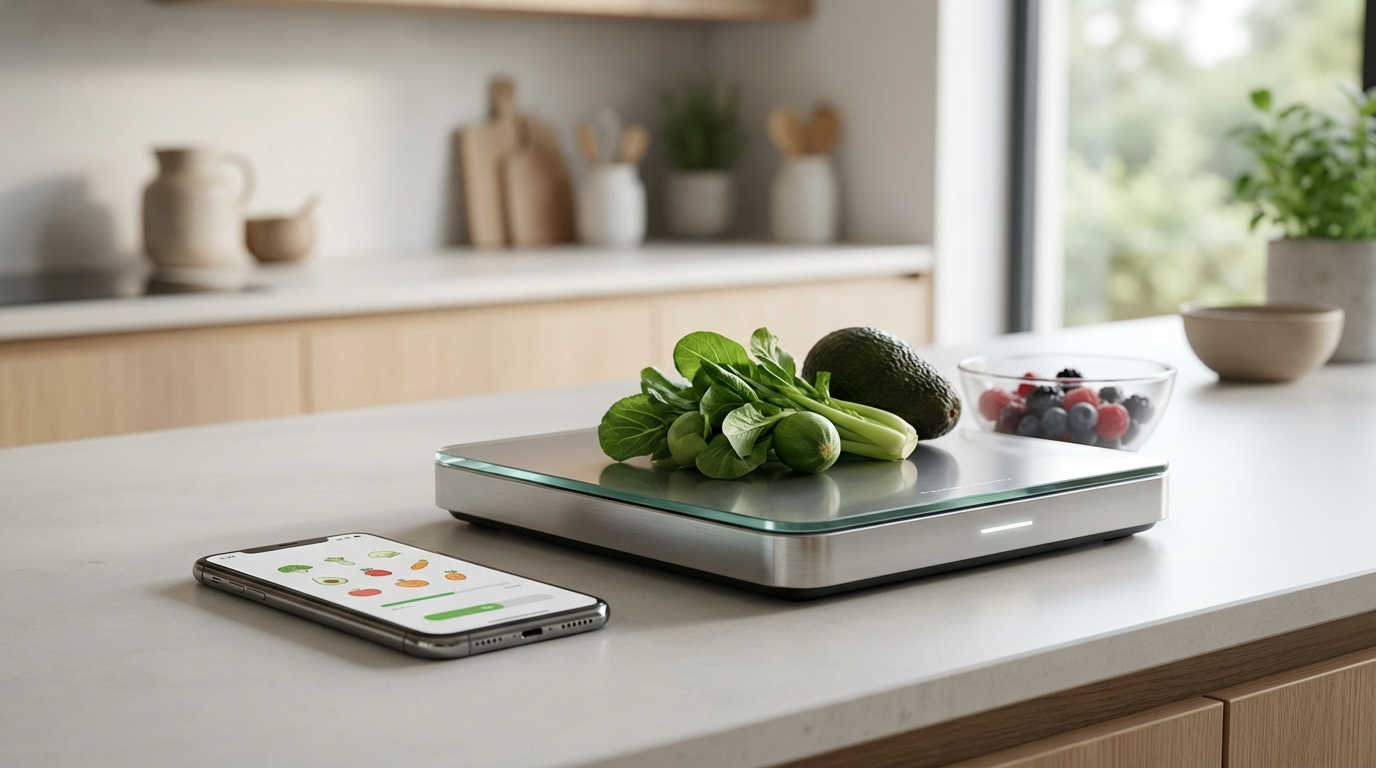
An ai kitchen scale combines traditional weighing technology with artificial intelligence to automatically identify foods and calculate their nutritional content.
Instead of weighing your food and then manually searching for it in an app, you simply place the item on the scale. The AI analyzes the food – often using computer vision, weight patterns, or both – and instantly provides calories, macros, and other nutritional information.
Think of it as having a nutrition expert built into your kitchen scale.
How AI Kitchen Scales Work: The Technology Behind Smart Food Tracking
Understanding how ai kitchen scales work helps explain why they're more accurate and convenient than manual logging.
Computer Vision Recognition
Many AI scales use built-in cameras or connect to your smartphone's camera to "see" what you're weighing. The computer vision system analyzes:
- Color patterns
- Texture
- Shape
- Size relative to weight
This visual data, combined with the precise weight measurement, helps the AI distinguish between similar foods. It can tell the difference between white rice and cauliflower rice, or identify whether your apple is a Granny Smith or Red Delicious.
Machine Learning Databases
Unlike static nutrition databases, AI systems learn and improve over time. They're trained on thousands of food images and nutritional profiles, becoming more accurate with each use.
The AI doesn't just match your food to a generic entry. It considers factors like:
- Regional food variations
- Seasonal differences in produce
- Common preparation methods
- Portion size context
Real-Time Nutritional Calculations
Once the food is identified, the smart food scale instantly calculates nutritional information based on the exact weight. No more guessing whether you have 4 oz or 6 oz of salmon – the AI knows precisely and adjusts the macro calculations accordingly.
Key Benefits: Why AI Beats Manual Calorie Logging
Speed and Convenience
The most obvious advantage is time savings. What used to take 2-3 minutes per food item now happens in seconds. Place food on scale, get instant nutrition data, move on with your life.
For people tracking multiple meals daily, this time savings adds up quickly.
Improved Accuracy
AI scales eliminate several sources of error in nutrition tracking:
- Portion estimation errors: The scale measures exact weights
- Database selection mistakes: AI chooses the most appropriate nutritional profile
- Calculation errors: Automated macro calculations based on precise measurements
Consistency
Manual logging often varies based on your mood, energy level, and available time. Tired after work? You might pick the first database entry you see. Rushing in the morning? You might skip logging altogether.
AI scales provide the same level of accuracy whether you're alert and focused or running on three hours of sleep.
Learning Your Patterns
Advanced AI systems learn your eating patterns and preferences. They might recognize that when you weigh chicken at 6 PM, it's probably seasoned and cooked rather than raw. This contextual awareness improves accuracy over time.
Real-World Example: A Day of Tracking
Let's compare manual logging versus using an ai kitchen scale for a typical day:
Manual logging morning:
- Weigh oatmeal: 1 minute
- Search for "rolled oats" in app: 2 minutes
- Add blueberries, search database: 2 minutes
- Add almond milk, search database: 1 minute
- Total time: 6 minutes
AI scale morning:
- Place bowl on scale, add oats: instant recognition and logging
- Add blueberries: instant update to nutritional totals
- Add almond milk: instant final calculations
- Total time: 30 seconds
Multiply this across three meals and snacks, and the time difference becomes significant.
Common Limitations and Considerations
Food Recognition Challenges
While AI technology is impressive, it's not perfect. Complex dishes with multiple ingredients can still pose challenges. A homemade stir-fry with ten different vegetables might require some manual input.
Most AI scales handle single ingredients and simple preparations very well, but elaborate recipes may need traditional logging methods.
Initial Learning Curve
Like any new technology, AI scales require some adjustment time. You'll need to learn how to position foods for optimal recognition and understand when the AI might need help identifying unusual items.
Cost Considerations
Smart food scales typically cost more than basic digital scales. However, many users find the time savings and improved accuracy worth the investment, especially if nutrition tracking is a daily habit.
Who Benefits Most from AI Kitchen Scales?
Serious Macro Trackers
If you're tracking macros for fitness goals, the precision and speed of an ai kitchen scale can be game-changing. Bodybuilders, athletes, and fitness enthusiasts often find the accuracy improvement alone justifies the upgrade.
Busy Professionals
Time-pressed individuals who want to track nutrition but struggle with the time commitment of manual logging often see the biggest quality-of-life improvement.
Consistency Seekers
People who start and stop nutrition tracking due to frustration with manual logging often find AI scales help them maintain consistent habits.
The Future of Smart Food Tracking
AI kitchen scale technology continues evolving rapidly. Future developments might include:
- Better recognition of complex, multi-ingredient dishes
- Integration with meal planning and grocery shopping apps
- Personalized nutritional recommendations based on tracking history
- Voice commands and hands-free operation
Making the Switch: What to Expect
If you're considering upgrading from manual calorie logging to an AI-powered system, expect a significant improvement in both speed and accuracy.
Qalzy's AI kitchen scale represents the current state of this technology, combining computer vision with machine learning to make nutrition tracking as simple as weighing your food. The system learns your preferences over time and integrates seamlessly with comprehensive macro tracking features.
For most people, the switch feels like upgrading from a flip phone to a smartphone – you wonder how you managed with the old method.
Frequently Asked Questions
How accurate are AI kitchen scales compared to manual logging?
AI kitchen scales are typically more accurate than manual logging because they eliminate portion estimation errors and database selection mistakes. While no system is 100% perfect, AI scales reduce the most common sources of tracking errors.
Can AI scales recognize all types of food?
Most AI scales excel with single ingredients and simple preparations but may struggle with complex dishes containing many ingredients. The technology improves constantly, with newer models recognizing increasingly diverse foods.
Do I need an internet connection to use an AI kitchen scale?
Most AI scales require internet connectivity for food recognition and nutritional database access. Some models store common foods locally for offline use, but full functionality typically requires an internet connection.
How long does food recognition take?
Modern AI scales typically recognize foods and calculate nutrition information within 2-5 seconds, compared to 1-3 minutes for manual database searching and selection.
Are AI kitchen scales worth the extra cost?
For regular nutrition trackers, the time savings and improved accuracy often justify the higher cost. If you track food daily or struggle with consistency in manual logging, an AI scale can significantly improve your experience.
Can AI scales help with meal planning?
Many AI scales integrate with apps that offer meal planning features. By understanding your eating patterns and preferences, these systems can suggest meals that fit your nutritional goals. Qalzy's meal planning tools work seamlessly with their AI scale to create a complete nutrition management system.
The Bottom Line
AI kitchen scales represent a significant step forward in making nutrition tracking more accessible and sustainable. By eliminating the tedious aspects of manual calorie logging while improving accuracy, they remove major barriers that prevent people from maintaining consistent tracking habits.
The technology isn't perfect, and it won't solve every nutrition tracking challenge. But for the millions of people who've tried and abandoned manual food logging due to frustration with the time and effort required, an ai kitchen scale might be exactly what they need to finally stick with their nutrition goals.
Whether you're trying to lose fat, maintain your current weight, or optimize your macro intake for performance, the combination of speed, accuracy, and convenience offered by AI-powered nutrition tracking tools can transform a daily chore into a simple, almost effortless habit.
Ready to see how much simpler nutrition tracking can be? Explore Qalzy's AI-powered approach to food tracking and discover why thousands of people have made the switch from manual logging to smart, automated nutrition management.