Why Portion Size Estimation Fails & What to Do Instead
Why Portion Size Estimation Fails and What to Do Instead
You've been there. Standing in your kitchen, holding a spoonful of peanut butter, trying to figure out if it's one tablespoon or two. Maybe you're eyeballing that chicken breast, wondering if it's closer to 4 ounces or 6. Sound familiar?
If you've ever tried tracking calories or macros, you know how frustrating portion size estimation can be. One day you're confident about your portions, the next you're completely second-guessing yourself. The truth is, most people are terrible at estimating food portions—and it's not your fault.
Let's dig into why portion size estimation consistently fails and explore better approaches that actually work for long-term success.
The Science Behind Why We're Bad at Estimating Portions
Humans are notoriously poor at judging food quantities. Research shows that even trained dietitians can be off by 20-40% when estimating portion sizes visually. For the average person, the margin of error is often much higher.
Several factors make accurate portion estimation nearly impossible:
Visual illusions mess with your brain. The same amount of food looks different depending on plate size, bowl depth, and even the color of your dishware. A 1-cup serving of rice appears smaller on a large white plate than on a small dark bowl.
Calorie density varies wildly. Two foods that look similar in size can have drastically different calorie counts. A handful of almonds packs about 160 calories, while the same visual portion of grapes contains roughly 60 calories.
Your hunger influences perception. When you're hungry, portions tend to look smaller than they actually are. When you're full, the opposite happens. Your brain literally changes how it processes visual information about food based on your current state.
Memory is unreliable. Even if you could estimate portions perfectly in the moment, remembering exactly what you ate hours later for logging purposes introduces another layer of inaccuracy.
Common Portion Control Mistakes That Sabotage Your Goals
Most calorie counting mistakes stem from these predictable portion estimation errors:
Underestimating High-Calorie Foods
Fats and oils are the biggest culprits here. That "drizzle" of olive oil you added to your salad? It's probably closer to 2-3 tablespoons (240-360 calories) rather than the 1 teaspoon (40 calories) you logged.
Nut butters, cheese, and salad dressings fall into this category too. These calorie-dense foods can single-handedly blow your daily targets if you're consistently underestimating portions.
The "Healthy Food" Bias
People tend to underestimate portions of foods they perceive as healthy. Avocados, nuts, quinoa, and smoothies often get the benefit of the doubt, leading to significant tracking errors.
A medium avocado contains about 320 calories, but many people log it as a "small" avocado to feel better about their choices. Over time, these small mental adjustments add up to big discrepancies.
Inconsistent Reference Points
Using your hand or common objects as portion guides sounds practical, but it breaks down quickly. Your "palm-sized" chicken breast might be different sizes depending on how you position your hand, how thick the meat is, or simply how you're feeling that day.
Forgetting About Cooking Methods
Raw vs. cooked weights can throw off your entire day. Four ounces of raw chicken breast becomes about 3 ounces when cooked, but the calorie content stays roughly the same. If you're logging cooked weights but using raw food data (or vice versa), your numbers will be consistently off.
What Actually Works: Practical Alternatives to Guesswork
Weighing Your Food (The Gold Standard)
A digital kitchen scale eliminates guesswork entirely. Weighing food provides accuracy within 1-2%, compared to the 20-50% error rate of visual estimation.
Start by weighing everything for one week. You'll quickly learn what actual portion sizes look like and how far off your estimates were. Many people discover they've been eating 30-40% more calories than they thought.
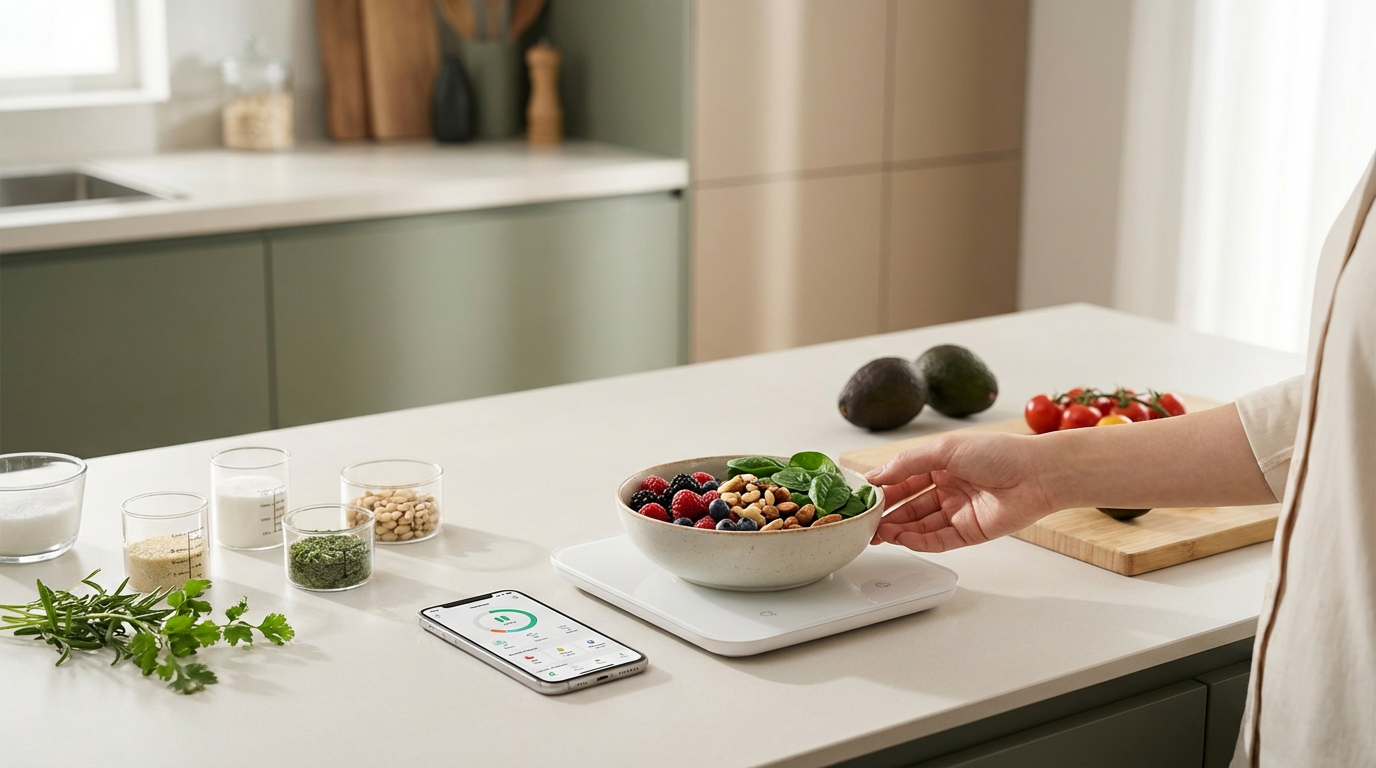
Modern solutions like Qalzy's AI-powered kitchen scale make this process even simpler by automatically identifying foods and logging nutritional data without manual database searches.
Strategic Measuring for Key Foods
You don't need to weigh every single thing you eat forever. Focus your measuring efforts on:
- Oils, butter, and cooking fats
- Nuts, seeds, and nut butters
- Grains, pasta, and cereals
- Protein sources (meat, fish, tofu)
- Calorie-dense snacks
For low-calorie vegetables, rough estimates are usually fine. Being off by 50% on lettuce or cucumber won't derail your progress.
Building Better Visual References
After weighing foods consistently, you'll develop more accurate visual cues. But instead of relying on generic hand measurements, create personal reference points using your own dishes and utensils.
Learn what 4 ounces of chicken looks like on your dinner plate. Memorize how much space 1 cup of rice takes up in your usual bowl. These personalized references are far more reliable than generic portion guides.
Pre-Portioning and Meal Prep
Batch cooking and pre-portioning removes daily estimation decisions entirely. When you divide a recipe into exact portions during meal prep, you know exactly what you're eating without any guesswork.
This approach works especially well for snacks. Pre-portion nuts, crackers, and other easy-to-overeat foods into individual containers or bags.
The Role of Technology in Accurate Food Portion Tracking
Smart kitchen tools are making accurate portion tracking more accessible than ever. Instead of manually searching food databases and calculating portions, AI-powered solutions can identify foods and provide instant nutritional information.
Qalzy's smart scale and app exemplifies this approach—simply place your food on the scale, and the AI identifies what you're eating and logs the macros automatically. This eliminates both the estimation errors and the tedious manual logging that causes most people to give up on tracking.
For people serious about their nutrition goals, investing in accurate tracking tools often pays for itself through better results and less wasted effort.
When Estimation Might Be Enough
Strict portion measurement isn't always necessary. If you're maintaining your weight successfully and feeling good about your food choices, rough estimates might work fine for you.
Estimation can also work as a stepping stone. Some people find that starting with loose portion awareness helps them build sustainable habits before progressing to more precise tracking.
However, if you're not seeing the results you want—whether that's fat loss, muscle gain, or better energy levels—inaccurate portions are often the hidden culprit.
Making the Transition: From Guessing to Knowing
Moving away from portion size estimation doesn't have to be overwhelming. Start small:
Week 1: Weigh just your protein sources and cooking oils. These two categories account for the biggest estimation errors.
Week 2: Add grains, pasta, and other carb sources to your weighing routine.
Week 3: Include nuts, seeds, and other calorie-dense snacks.
By the end of three weeks, you'll have dramatically improved your tracking accuracy without trying to change everything at once.
Many people find that using tools like Qalzy's nutrition calculator helps them understand their actual needs better, making the transition to accurate tracking feel more purposeful.
The Bottom Line: Accuracy Enables Results
Portion size estimation fails because our brains aren't designed to be precise measuring tools. The visual tricks, cognitive biases, and memory limitations that make us human also make us terrible at judging food quantities.
But here's the good news: you don't have to live with inaccurate tracking forever. Whether you choose to weigh your food, use smart kitchen technology, or focus on pre-portioning strategies, moving beyond estimation gives you the data you need to actually reach your goals.
The most successful people in nutrition aren't the ones with perfect willpower—they're the ones with accurate information. When you know exactly what you're eating, you can make informed decisions about your health instead of hoping your guesses are close enough.
Ready to move beyond portion guesswork? Qalzy's AI-powered tracking system makes accurate nutrition monitoring simple and sustainable, so you can focus on results instead of estimation errors.
Frequently Asked Questions
How far off are most people when estimating portion sizes? Studies show that even trained professionals can be off by 20-40% when estimating portions visually. For untrained individuals, errors of 50% or more are common, especially with calorie-dense foods like oils, nuts, and cheese.
Do I need to weigh food forever to be successful? Not necessarily. Many people find that weighing food for 4-8 weeks helps them develop much better visual estimation skills. However, if you're pursuing specific body composition goals, ongoing accuracy usually produces better results.
What foods are most important to measure accurately? Focus on calorie-dense foods where small portions pack a big nutritional punch: cooking oils, nuts, seeds, nut butters, cheese, and protein sources. Being slightly off on low-calorie vegetables won't significantly impact your goals.
Can apps alone solve portion estimation problems? Apps that rely on manual logging still depend on your ability to estimate portions accurately. However, AI-powered solutions that work with smart scales can eliminate the guesswork entirely by automatically identifying and weighing your food.
Is it worth investing in a smart kitchen scale? If you're serious about reaching specific nutrition goals, a quality scale typically pays for itself through better results and time savings. Smart scales that integrate with apps can make the process even more streamlined and sustainable.
How do I handle eating out when I can't measure portions? When dining out, focus on the skills you've learned from measuring at home. Choose simpler preparations when possible, ask for dressings and sauces on the side, and don't stress about perfect accuracy for occasional meals. Consistency at home matters more than perfection everywhere.