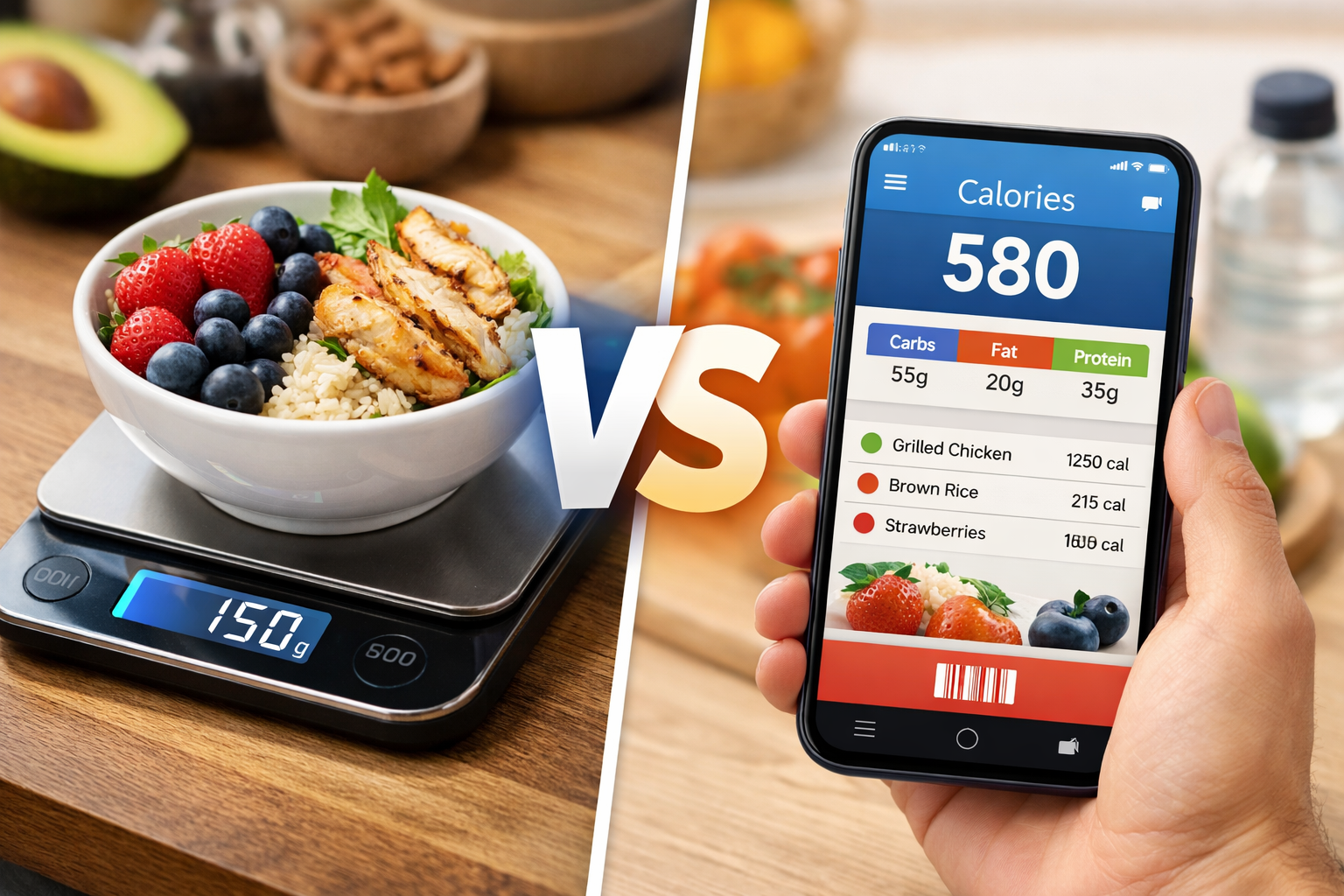
Food Scale vs Calorie App: Which Is More Accurate?
Understanding Calorie Tracking Accuracy
When it comes to weight loss, muscle gain, or improving nutrition, many people rely on calorie tracking apps. These apps allow users to log food and estimate calories throughout the day. However, another tool widely used by nutritionists and fitness enthusiasts is a food scale.
So which method is more accurate for tracking calories?
Short answer: A food scale is significantly more accurate than relying on calorie apps alone because it measures the exact weight of food rather than estimating portion size.
Understanding the difference between these tools can help you track calories more accurately and build sustainable healthy habits.
What Is a Food Scale?
A food scale is a kitchen device that measures the weight of food, usually in grams or ounces, allowing users to calculate calories and nutrients more precisely.
Food scales are commonly used for calorie tracking, portion control, baking precision, and macro tracking.
By weighing food instead of estimating portions, users can significantly reduce calorie tracking errors.
For example, visually estimating one tablespoon of peanut butter often results in portions that are 30–50% larger than intended.
What Is a Calorie Tracking App?
A calorie tracking app is a mobile application that allows users to log foods and estimate calories using large nutrition databases.
Popular calorie tracking apps include MyFitnessPal, Lose It, Cronometer, and MacroFactor.
These apps work by allowing users to search for foods, scan barcodes, and manually enter portion sizes to calculate calorie intake.
While convenient, calorie tracking apps rely heavily on user input and portion estimation, which can introduce inaccuracies.
The Biggest Problem With Calorie Apps: Portion Estimation
One of the biggest sources of calorie tracking error is portion estimation.
Most people log foods using vague descriptions such as “a bowl of pasta” or “one chicken breast.” However, these portions vary significantly depending on preparation and serving size.
Research shows that many people underestimate calorie intake by 20–40% when estimating portions visually.
Even small daily errors can accumulate over time and prevent consistent weight loss progress.
Food Scale vs Calorie App: Accuracy Comparison
The table below compares the main differences between food scales and calorie tracking apps.
| Feature | Food Scale | Calorie App |
|---|---|---|
| Portion accuracy | High | Low to Medium |
| Ease of use | Medium | High |
| Risk of logging errors | Low | High |
| Automation | Low | Medium |
| Nutritional calculation | Requires app | Built-in |
Why Food Scales Improve Calorie Accuracy
Food scales eliminate the need to visually estimate portions. By measuring the exact weight of food, users can calculate calories more precisely using nutrition databases.
This makes food scales particularly useful for people following structured diets, tracking macros, or working toward specific fitness goals.
Many nutrition professionals recommend using food scales during the early stages of calorie tracking because they help people develop a better understanding of portion sizes.
The Future of Calorie Tracking
While food scales improve measurement accuracy, traditional calorie tracking still requires users to manually log foods into an app.
This can become tedious over time and lead to logging fatigue.
New smart kitchen devices are beginning to automate this process.
An AI calorie tracking scale like Qalzy automatically identifies food using computer vision and records the weight and calories instantly in a companion app.
By combining precise food measurement with automatic logging, these tools remove the two biggest barriers to calorie tracking: portion estimation and manual entry.
Key Takeaways
Food scales and calorie tracking apps both play important roles in nutrition tracking.
Food scales improve accuracy by measuring exact food weight, while apps make it easier to log and analyze nutrition data.
For the most reliable calorie tracking, many people combine both tools to reduce estimation errors and maintain consistent habits.
As technology evolves, smart food recognition scales are making calorie tracking even easier by automating the entire logging process.
Related Articles
Want to learn more? Read our related guides:
Qalzy – AI scale for automatic calorie counting
What Is the Best Way to Track Calories?
FAQ
Are food scales more accurate than calorie apps?
Yes. Food scales measure the exact weight of food, which improves calorie
tracking accuracy compared to estimating portions in an app.
Why do people underestimate calories?
Most people underestimate calories because they visually misjudge portion sizes
and forget ingredients such as oils, sauces, or snacks.
Do nutritionists recommend using food scales?
Yes. Many nutritionists recommend food scales for people who want to learn
portion sizes or track macros accurately.
What is the easiest way to track calories accurately?
The easiest method combines precise food weighing with automated calorie logging
to reduce manual input and estimation errors.