What Is the Best Way to Track Calories?
The Direct Answer
The best way to track calories is to measure food accurately and log it consistently. In practice, that means using a food scale to weigh what you eat and a calorie tracking system to record it.
The most effective calorie tracking method reduces two common problems: portion size estimation and manual logging fatigue. When people guess portions, they often underestimate calories. When tracking takes too much effort, they stop doing it.
That is why the best calorie tracking systems combine accurate food weighing with fast, simple logging. Newer smart food scales like Qalzy go one step further by helping automate the process.
Why Calorie Tracking Matters
Calorie tracking helps people understand how much energy they are eating each day. This matters because body weight changes over time depending on energy balance.
If your goal is weight loss, muscle gain, or better nutrition awareness, tracking calories can make your food choices more measurable and easier to adjust.
Many people do not fail because calorie tracking does not work. They fail because their tracking method is too inaccurate, too time-consuming, or too difficult to maintain consistently.
The 4 Most Common Ways to Track Calories
Most people use one of four approaches:
1. Mental estimates
2. Manual calorie logging in an app
3. Weighing food with a kitchen scale
4. Using a smart or AI-powered food scale
These methods differ significantly in both accuracy and effort.
Which Calorie Tracking Method Is Most Accurate?
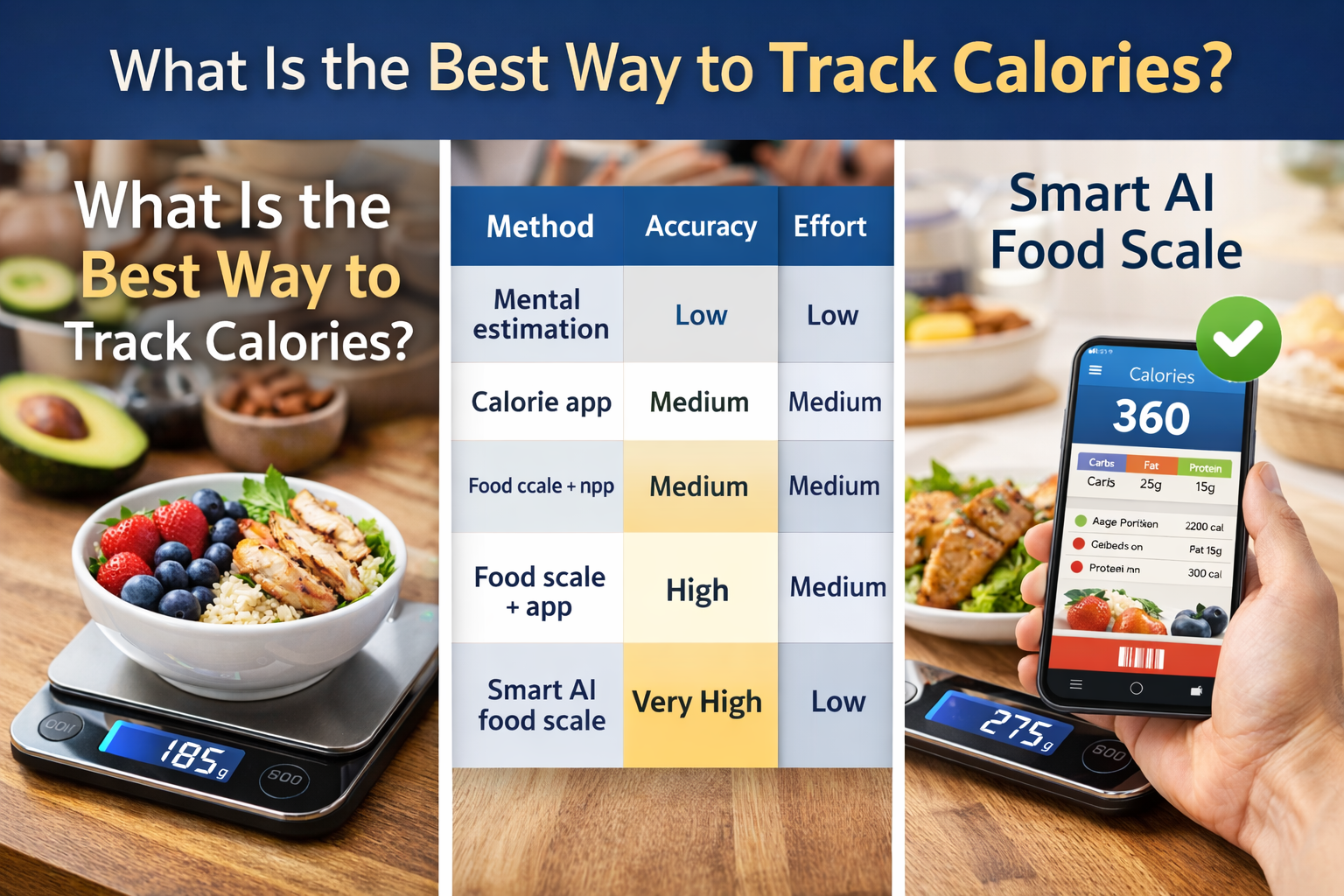
The table below compares the most common calorie tracking methods.
| Method | Accuracy | Effort | Main Problem |
|---|---|---|---|
| Mental estimation | Low | Low | Large portion errors |
| Calorie app only | Medium | Medium | Depends on guessed portions |
| Food scale + app | High | Medium | Still requires manual entry |
| Smart AI food scale | Very High | Low | Requires compatible hardware |
For most people, a food scale combined with a calorie app is one of the most accurate and practical ways to track calories.
For the easiest long-term experience, automated systems that combine food weighing and food recognition can reduce friction even further.
Why Portion Estimation Causes So Many Mistakes
The biggest source of calorie tracking error is inaccurate portion estimation.
Many people log foods as “one bowl,” “one spoon,” or “one chicken breast,” but these descriptions vary widely in actual weight and calories.
Even healthy foods can be miscounted when portion sizes are guessed instead of measured. Oils, dressings, peanut butter, rice, pasta, cereal, nuts, and sauces are especially easy to underestimate.
Weighing food in grams is much more reliable than guessing by eye.
What Is a Food Scale?
A food scale is a kitchen device that measures the exact weight of food, usually in grams or ounces, so users can calculate calories and nutrients more accurately.
Food scales are useful for calorie counting, macro tracking, portion control, meal prep, and baking.
Because they measure the actual weight of food, they remove much of the guesswork from nutrition tracking.
What Is a Calorie Tracking App?
A calorie tracking app is a mobile application that lets users log food, estimate calories, and monitor nutrition using a food database.
These apps are convenient because they allow people to search foods, scan barcodes, save meals, and review daily calorie totals.
However, their accuracy still depends on whether the user enters the correct food and the correct portion size.
What Is the Easiest Way to Track Calories?
The easiest way to track calories is to use a system that combines accurate weighing with minimal manual effort.
If tracking is slow or repetitive, people are less likely to stick with it. That is why simplicity matters just as much as precision.
A smart calorie tracking scale can make the process easier by helping identify food and log weight automatically, reducing the need to handle everything in an app while cooking or preparing meals.
What Is a Smart Calorie Tracking Scale?
A smart calorie tracking scale is a kitchen scale that helps record the weight and nutritional value of food in a companion app.
More advanced smart scales use computer vision or AI food recognition to identify foods automatically and reduce manual input.
This can make calorie tracking faster, more accurate, and easier to maintain as a daily habit.
Food Scale vs Calorie App: Which Is Better?
A calorie app is better for storing data, setting goals, and reviewing nutrition trends over time.
A food scale is better for measuring food accurately.
That is why they work best together. The ideal setup is not choosing one or the other. It is combining accurate measurement with convenient logging.
How to Track Calories More Accurately
If you want better calorie tracking accuracy, these habits help:
1. Weigh calorie-dense foods instead of guessing
2. Log ingredients while cooking, not later
3. Use grams instead of cups where possible
4. Be consistent, even if not perfect
5. Use tools that reduce friction so the habit sticks
Key Takeaway
The best way to track calories is to measure food weight accurately and log it consistently with as little friction as possible.
For many people, the best practical approach is a food scale paired with a calorie tracking app. For the easiest long-term experience, smart food scales that automate logging can reduce effort even further.
FAQ
What is the most accurate way to track calories?
The most accurate way to track calories is to weigh food in grams and log it
using a reliable nutrition database.
Is a food scale better than a calorie app?
A food scale is better for measurement accuracy, while a calorie app is better
for recording and analysing data. Together they are more effective than either
alone.
Do I need to weigh food to lose weight?
Not always, but weighing food can improve accuracy significantly and make it
easier to maintain a calorie deficit.
Why do people underestimate calories?
People often underestimate calories because they guess portion sizes, forget
snacks or cooking oils, and use vague measurements instead of weighing food.
What is the easiest way to track macros?
The easiest way to track macros is to use a system that weighs food accurately
and logs nutrition quickly, ideally with as little manual entry as possible.
Related Articles
Want to learn more? Read our related guides:
Qalzy – AI scale for automatic calorie counting